|
Report
from "Scientific Lectures on Health and Dietetics 2005"
The Japan Dietetic Association and Vitamin Information
Center hold scientific lectures on the dietetic association members
of various prefectures as a part of the dietetic education program.
These lectures are provided to contribute to maintenance/improvement
in the health of Japanese citizens by holding lectures for dietitians
who are expected as the human power for instruction on health and
nutrition so that they understand the special knowledge and use
it for future activities, leading to individual recognition on health
as well as correct understanding on nutritional balance and its
roles. In this year, lectures were hosted by the Dietetic Associations
of Tochigi and Yamanashi Prefectures as follows, and this article
introduces an outline of these lectures:
|
| 1st lecture |
|
| Host: |
the Japan Dietetic Association, the Dietetic Association
of Tochigi Prefecture, Co-host: Vitamin Information Center |
| Date and time: |
October 16, 2005 (Wed), Venue: Utsunomiya |
| Program: |
"Relationship between Antioxidant Vitamins and Lifestyle-Related
Diseases - Based on the Recent Outcomes" |
| |
by Professor Osamu Igarashi, Ibaraki Christian University |
| |
"Relationship between Catechin and Health" |
| |
by Dr. Masashi Ohmori, Dean, Faculty of Domestic Science,
Otsuma Women's University |
| 2nd Lecture |
|
| Host: |
the Japan Dietetic Association, the Dietetic Association
of Yamanashi Prefecture, Co-host: Vitamin Information Center |
| Date and time: |
October 19, 2004 (Sat), Venue: Kofu |
| Program: |
"Relationship between Polyunsaturated Fatty Acids and
Lifestyle-Related Diseases" |
| |
by Ms. Fumiko Hirahara, Adjunct Instructor, the Saiki Nutrition
College |
|
Relationship between Antioxidant
Vitamins and Lifestyle-Related Diseases |
- Based on the Recent Outcomes |
Professor Osamu Igarashi, College
of Life Sciences, Ibaraki Christian University |
|
|  We humans have fought against infectious diseases and lifestyle-related
diseases for a long time. At present, the society is aging rapidly
and even the infectious diseases that we succeeded in reducing such
as tuberculosis can cause serious problems in aging societies. The
so-called lifestyle- related diseases including cerebrovascular
diseases and cancer occupy a large ratio of recent causes of death.
While diet is considered a significant factor for lifestyle-related
diseases, another important factor is oxidation. We are surrounded
by the sources of active oxygen or free radical that cause oxidation
such as tobacco smoke, pollutants and ultraviolet radiation. Though
not all diseases occur because of free radicals, it is true that
they are related. Several per cent of the oxygen that we require
for living change into active oxygen or free radical. If this occurs
excessively, the lipids that re most easily oxidized is oxidized
first, followed by degeneration of DNA and proteins that lead to
diseases such as cancer and arteriosclerosis. What we call the antioxidant
enzymes in our bodies and the antioxidants we take in from outside
our bodies prevent such oxidation. A typical antioxidant enzyme
is SOD (superoxide dismutase). It has been shown that the higher
the activity of this SOD is, the longer the expected life of the
animal is when comparing the activities of SOD between humans and
other animals. Similarly for the blood concentration of vitamin
E, which is another typical antioxidant found in our blood, the expected
life grows longer as the blood concentration reaches higher. Representatives
of
We humans have fought against infectious diseases and lifestyle-related
diseases for a long time. At present, the society is aging rapidly
and even the infectious diseases that we succeeded in reducing such
as tuberculosis can cause serious problems in aging societies. The
so-called lifestyle- related diseases including cerebrovascular
diseases and cancer occupy a large ratio of recent causes of death.
While diet is considered a significant factor for lifestyle-related
diseases, another important factor is oxidation. We are surrounded
by the sources of active oxygen or free radical that cause oxidation
such as tobacco smoke, pollutants and ultraviolet radiation. Though
not all diseases occur because of free radicals, it is true that
they are related. Several per cent of the oxygen that we require
for living change into active oxygen or free radical. If this occurs
excessively, the lipids that re most easily oxidized is oxidized
first, followed by degeneration of DNA and proteins that lead to
diseases such as cancer and arteriosclerosis. What we call the antioxidant
enzymes in our bodies and the antioxidants we take in from outside
our bodies prevent such oxidation. A typical antioxidant enzyme
is SOD (superoxide dismutase). It has been shown that the higher
the activity of this SOD is, the longer the expected life of the
animal is when comparing the activities of SOD between humans and
other animals. Similarly for the blood concentration of vitamin
E, which is another typical antioxidant found in our blood, the expected
life grows longer as the blood concentration reaches higher. Representatives
of
|
antioxidant vitamins taken from outside
the body
are Beta-carotene (provitamin A), vitamin C, and vitamin E, and
these cannot be synthesized in our bodies. Besides these, the carotenoids
contained in green and yellow vegetables also deliver antioxidant
activities.
Cardiovascular Diseases and Vitaminsbiotin
Blood pressure and smoking were considered as risk factors
of cardiovascular diseases for approximately 20% of the patients,
and hypercholesterolemia, obesity, diabetes, etc. were also considered
factors in the past. While many studies have been actively implemented
on the relationship between vitamin E (alpha-tocopherol) and heart
diseases, a negative correlation in which the death rates were lower
in nations with high levels of intake was found when a study focused
on the relationship between the level of alpha-tocopherol intake
and death rate by coronary artery diseases. The results were similar
to those of a study on the relationship between red wine intake
level and death rate by coronary artery diseases. If you focus on
the relationship between food product/nutrition element and death
rate by heart diseases in Europe, U.S. and Japan, a strong negative
correlation is seen for alpha-tocopherol and red wine. Though there
was also a negative correlation with the intake level of vegetable
oil, it is considered to be caused by the vitamin E which is contained
richly in vegetable oil. Though some recent data report that there
is no correlation between vitamin E and heart diseases, I say that
the effect of vitamin E can be expected based on the numerous study
reports in the past. Vitamin E is also noted for its relativity
to the progress of |
| Alzheimer's disease in addition
to heart diseases.
As to heart diseases, recent studies revealed that a substance
called homocysteine is another factor besides vitamin E. There
are many studies reporting that a higher blood concentration
of homocysteine leads to a higher risk for heart diseases.
Though we Japanese originally have low blood concentrations
of homocysteine, innate homocysteine metabolism deficits have
been found in the past. The coenzymes related to the metabolism
of this homocysteine are folic acid, vitamin B12, and vitamin
B6. Especially the effect of folic acid seems large. Though
Japanese people rarely have shortage in vitamin B12 because
it can be taken from shellfish, people who had gastric resection
in the past may have malabsorption and fall short. The intake
level of folic acid varies greatly by the nation, and there
are also large individual differences according to the results
of a study on female college students in Japan. Caution is
required that many people do not satisfy the recommended intake
levels. Folic acid must be taken with care especially by women
because it is deeply involved with the crisis of birth defects
for the fetus.
Gamma-Tocopherol
As to vitamin E (tocopherol), attention is recently gathered
on gamma-tocopherol. Since alpha-TPP transports only alpha-tocopherol
in the liver 90% of tocopherol in blood is alpha-tocopherol
with gamma-tocopherol comprising only about 10%, it was conventionally
considered that the activity of only alpha-tocopherol was
important. However, it has recently been discovered that gamma-tocopherol
side chain is cut short in the body to become gamma-CEHC (carboxyethyl
hydroxychromans) and that it has an effect to promote sodium
excretion. It is only humans among all land-dwelling animals
that may take too much salt, and intake of gamma-tocopherol
which is the source of gamma-CEHC with salt excretion effect
is considerably important. Further studies are expected.
CoQ10 (Coenzyme Q10)
One of the antioxidant substances that are often on the topic
recently is CoQ10. CoQ10 is biosynthesized in our bodies and
had been used as a treatment drug for congestive heart failure
first. It was recently approved as a food product. The
|
Food Safety Commission,
etc. are still discussing on its recommended intake level
and upper limit level, and the values are still to be clarified.
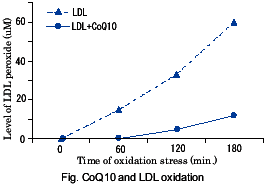
The effect of CoQ10 is very high in suppressing LDL oxidation
(Fig.), and its highest concentration exists in the heart
which continues to pump out the blood without rest. The next
highest concentration exists in kidneys which require great
energy for producing primary urine and concentrating it. Since
the deficiency in CoQ10, intake effect, etc. vary greatly
among individuals, it is not suggested that all people should
actively take supplements. However, CoQ10 in our bodies gradually
decrease in concurrence to aging. Thus senior citizens need
to take it with care. Though it is also said that it works
on various diseases, there is no cut and dry answer to this
because there are large individual differences to this as
well. For example, those who take cholesterol-lowering statin
drugs are apt to fall deficient in CoQ10. This is because
the paths of synthesis are nearly identical between CoQ10
and cholesterol, and inhibition of cholesterol synthesis also
means inhibition of CoQ10 synthesis as well. In the U.S.,
they take the measures to administer CoQ10 at the same time
to those who use statin drugs, etc. It may be a good idea
to use supplements if deficiency may occur due to aging, diseases
or administration of certain drugs.
As you can see, antioxidants such as vitamin E, vitamin C
and CoQ10 are essential for maintenance or improvement of
our health. I suggest that supplements, etc. should be used
well considering the dietary life and nutritional conditions
of oneself.
|
Relationship between Catechin
and Health
Prof. Masashi Ohmori, Dean, Faculty of Domestic Science,
Otsuma Women's University
|  I think the word "health" is a very important
word. When I looked it up on a dictionary, it said "well-being
of body and mind without ailments." You may also see
the sentence, "health is not having any diseases."
At present, the definition of health by WHO (World Health
Organization), "Health is a state of complete physical,
mental and social well-being and not merely the absence
of disease or infirmity. The enjoyment of the highest attainable
standard of health is one of the fundamental rights of every
human being without distinction of race, religion, political
belief, economic or social condition" is most globally
accepted. To obtain health, I always insist on the importance
of daily satisfaction of the 5 pleasures, "eating well,
sleeping well, evacuating well, sweating well and feeling
well."
I think the word "health" is a very important
word. When I looked it up on a dictionary, it said "well-being
of body and mind without ailments." You may also see
the sentence, "health is not having any diseases."
At present, the definition of health by WHO (World Health
Organization), "Health is a state of complete physical,
mental and social well-being and not merely the absence
of disease or infirmity. The enjoyment of the highest attainable
standard of health is one of the fundamental rights of every
human being without distinction of race, religion, political
belief, economic or social condition" is most globally
accepted. To obtain health, I always insist on the importance
of daily satisfaction of the 5 pleasures, "eating well,
sleeping well, evacuating well, sweating well and feeling
well."
|
Eating
well: As suggested by the Ministry of Health, Labor
and Welfare, it is to eat 31 different food items a day.
Japan is fortunately rich in rice, tea, fish, soybean, etc.
Though they may be disregarded in the present days with
variety of food products, balanced diet centering on Japanese
traditional meals seems to be most important for our health.
Sleeping well: The symptom
of not being able to sleep leads to the lack of mental health.
It is recommended that about 7 hours of sleep should be
used as the target for sleep every night.
Evacuating well:
The habit of having daily evacuation
is important.
Sweating well: It is important
to sweat by jogging, exercising, etc. to suit one's taste
or lifestyle.
Feeling well: Laughing with
your mouth wide open brings good mental health.
"Eating" among the 5 pleasures above is of course
the final and most important factor in maintaining health.
While we |
|
| |
| used to take 70~80% of
energy intake from grains, it has decreased to about
50% these days with increased intake of lipids. It is
true that food tastes better when you cook with oil,
but the problem of oxidation must be considered when
the intake level of oil increases. The current dietary
life has fallen into a situation in which health damage
by lipid peroxides, etc. cannot be easily prevented
unless we consciously take antioxidants.
In Japan, people drank green tea with Japanese traditional
meals from the old times. The only nations that produce
and drink green tea are Japan, China, Viet Nam and Myanmar.
While tea had been treated as a drug for various organs
(kidneys, heart, lungs, etc.), the reason it was called
a drug was caffeine. Caffeine is the factor for reducing
the headache that occurs in case of hangover. Though
the history of tea in Japan goes way back, it was only
1991 when the studies on the components of tea including
this caffeine were advanced and the international conference
for reporting the results was held for the first time
in Japan. In this international conference, catechin
was in the spotlight instead of caffeine and most of
the study reports were on catechin. Catechin transport
substance in blood, in vivo functions, etc. are being
clarified one by one even today.
Catechin has an antioxidant effect and is expected
to be effective on diseases that may be caused by oxidation
such as cancer in Japanese people who have higher lipid
intake levels. A study on people living in Shizuoka
Prefecture (Oguni et al.) has revealed that the rate
of cancer genesis and morbidity rate of digestive system
diseases are lower in areas with high levels of tea
intake. Catechin is divided into different types called
EC (epicatechin), EGC (epigallocatechin), ECG (epicatechin
gallate) and EGCG (epigallocatechin gallate). EGCG exists
in the highest concentration in green tea at 50% or
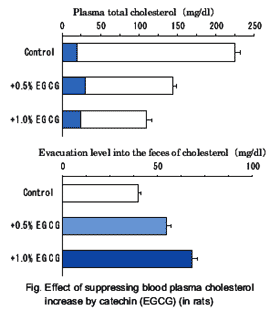
higher. It has been shown in animal experiments that
the serum cholesterol concentration decreased dose-dependently
when EGCG (epigallocatechin gallate) with relatively
high antioxidant activity among these catechins is administered.
Furthermore, it has been revealed that simultaneous
administration of EGCG and lipids inhibit oil absorption
and
|
increased
evacuation level into the feces (Fig.).
While the green tea variety called "Yabukita"
is most popularly distributed in Japan, it has just
been discovered that the variety called "Benifuki"
contains methylated catechin which has antiallergic
activity. Since the number of allergy patients is increasing
in Japan and causing a serious problem, it is desired
that further study will be implemented on the variety
of tea and its components with such effects. Besides
catechin, theanine, an amino acid contained in green
tea is also under the spotlight. Studies are being implemented
on its effect by aromatherapy and relaxation with theanine.
As you can see, many studies are implemented on tea
components. However, the action to drink tea leads to
the action of offering hospitality to others, which
also works in promoting communication among people.
|
Relationship between
Polyunsaturated Fatty Acids and Lifestyle-Related Diseases
Dr. Fumiko Hirahara, Adjunct Instructor, the Saiki
Nutrition College
|  At present, 60% or more of all deaths of Japanese
people are caused by lifestyle-related diseases, and
most of them are ascribed to dietary life. Dietary
life is also considered to lie in the background for
Japan to have become a nation of longevity, and it
is a known fact that the Japanese traditional meals
are globally placed in the spotlight and are being
studied. Japan has had leading activities in terms
of nutrition in the world, and it was Dr. Saiki of
Japan who created the position of dietitian and trained
them. Japan is also the first nation to develop functional
food products. As you can see, Japan has regarded
the field of nutrition with importance and continued
national nutrition surveys that are unprecedented
in any other parts of the world for a long period
to use the data in grasping the nutritional status
of the citizens, establishment of food intake standards,
health
At present, 60% or more of all deaths of Japanese
people are caused by lifestyle-related diseases, and
most of them are ascribed to dietary life. Dietary
life is also considered to lie in the background for
Japan to have become a nation of longevity, and it
is a known fact that the Japanese traditional meals
are globally placed in the spotlight and are being
studied. Japan has had leading activities in terms
of nutrition in the world, and it was Dr. Saiki of
Japan who created the position of dietitian and trained
them. Japan is also the first nation to develop functional
food products. As you can see, Japan has regarded
the field of nutrition with importance and continued
national nutrition surveys that are unprecedented
in any other parts of the world for a long period
to use the data in grasping the nutritional status
of the citizens, establishment of food intake standards,
health
|
control, etc. While
traditional Japanese meals were reconsidered as the
number of lifestyle-related diseases increased and
the society aged, it is also noted that the effect
of lipid intake is also large when focusing the effect
by the nutrient.
The current studies on lipids have advanced on to
breakdown to fatty acids, and there are many studies
on individual fatty acids including arachidonic acid,
linoleic acid, EPA and DHA, revealing various functions
and effects on our health. One incidence for fatty
acids to be in the spotlight was the NI-HON-SAN Study.
This was a study on the morbidity rates of heart diseases
for Japanese people living in Japan and Japanese people
living in Honolulu and San Francisco which revealed
difference in the morbidity rate although these groups
had the same racial genes. As a result of studying
the dietary life, it was considered that the difference
in lipid intake with lower intake of saturated fatty
acids in the group living in Japan than the groups
living in other nations led to the difference in morbidity
rate. |
|
| Furthermore, a study that compared
the dietary lives of theJapanese people in the 1960s, the
Japanese people in the1980s and the American people in 1985
showed that thelevel of saturated fatty acid intake was
higher in the U.S.than in Japan, and higher in the 1980s
than in the 1960s inJapan. Focusing on the ratio between
n-6 type unsaturatedfatty acids and n-3 type unsaturated
fatty acids, the valuehas been gradually increasing from
approximately 3 in the 1960s. The n-6/n-3 ratio is also
high in the U.S., and it isconsidered a factor for increased
number of heart diseases.To lower the morbidity rate of
heart diseases, the Japanesemeals of the 1970s seem to be
ideal. Furthermore, it wasfound that the types of component
fatty acids also affect thenumber of deaths in addition
to the level of lipids in a study
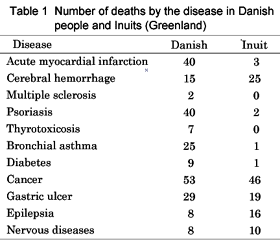
which compared the Danish people and Inuit people in Greenland,
because the number of deaths by myocardial infarction was
extremely small in Inuit people who had high intake of total
lipids but was high in concentration of EPAwhen blood concentrations
of fatty acids were focused. In Nures's Health Study, the
correlation between the level offish intake and rate of
death by myocardial infarction was discovered. Similar results
were reported by the Harvard's Physicians' Health Study
and the GISSI Study, and studies of this type are still
being implemented even today.
Beginning with the study on the relationship between fish
intake and fatty acid metabolism, the effects of fatty acids
contained in fish, especially EPA and DHA on lipid metabolism
have been revealed in recent
|
years.
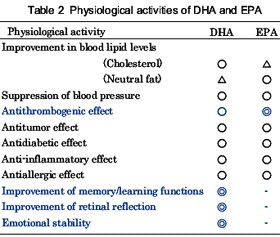
We now know that DHA intake lowers the blood cholesterol
concentration and EPA intake lowers the blood neutral fat
level. By clarifying the functions of each fatty acid, it
is possible to utilize the fatty acids to be administered
depending on the type of disorder in treatments on hyperlipemia
patients by administering EPA on patients who are apt to
form thrombus for instance.
More recently, the antiallergic effects of the n-3 type
unsaturated fatty acids are under the spotlight. Our normal
meals have relatively high intake levels of linoleic acid
type(n-6 type) fatty acids with a high n-6/n-3 ratio, and
it is considered that this is because our fish intake is
insufficient.
Increase in linoleic acid intake is suspected as one of
the causes for increased number of allergy patients, and
there are reports suggesting that intake of n-3 type unsaturated
fatty acids by atopic disease patients reduces the inflammation.
Considering such results, instruction on nutrition may be
provided for allergic disease patients and hyperlipemia
patients in order to reduce the intake level of n-6 type
unsaturated fatty acids and bring the n-6/n-3 ratio as close
to 1 as possible. However, it is important for healthy people
to keep the n-6/n-3 ratio balance to 4:1 instead of reducing
the intake levels of n-6 type unsaturated fatty acids.
Another hot topic is the existence of a relationship between
DHA and brain functions. There are more and more questions
asking "do you become smarter if you take DHA?"
Though it is not completely false, it is true that the effect
is so visibly significant by only taken it in a large volume.
However, DHA does exist in the brain and taking it is
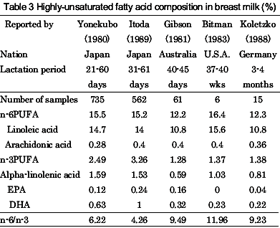
important to activate its functions. Comparing the
compositions of intermediate to polyunsaturated fatty acids
in breast milk in various nations, the n-6/n-3 ratio is
found to be lower in Japan than in the U.S. or Germany.
It is possible that DHA intake may actually improve the
brain functions, and appropriate lipid intake by the mother
is desired in order to avoid lowering in the intake level
of n-3 type unsaturated fatty acids during the infant stages.
Today we live in information society and consumers are able
to obtain various different data from TV, Internet, and
so on.
However, not all data are correct and I hope that you should
have correct knowledge and work toward proper instruction
and education of the consumers as specialists.
|
|
| |
| |
|
