|
"Seminar fot Dietitian" Report
Spomsored by: The Jpan Dietetic
Association, Ehime Dietetic Assocation and Vitamin Information Cente
Date: September 11, 2004 (SAT) At RIHGA ROYAL HOTEL NIIHAMA
|

The Japan Dietetic Association and Vitamin Information Center
have held scientific lectures on dietitians in many prefectures
as a part of the Nutrition Educational Program. Diverse health
food products and drinks fill the current market, and there are
more and more questions from patients and consumers about health
foods and their functional ingredients. Therefore, this lecture
intends to contribute to maintenance and improvement of national
health by holding lectures for dietitians who are expected as
the human power in health and nutrition instruction for more special
understanding to add to future activities, so that the individual
recognition on health is increased and the balance in nutrients
and the role of each are understood properly. On September 11,
2004, we asked Professor Toshiaki Watanabe from University of
Hyogo to talk about "Physiological Functions of Biotin and Its
Effect on Health," and Professor Satoshi Moriguchi from Yamaguchi
Prefectural University on "Sports and Vitamins" for approximately
120 dietitians member to Ehime Dietetic Association in Niihama
City, Ehime Prefecture. The following introduces the lectures.
|
|
Physiological Functions of Biotin
and Its Effect on Health
Professor Toshiaki Watanabe,
School of Human Science and EnvironmentUniversity of Hyogo
|
|
 Vitamins
are defined as organic compounds that cannot be synthesized by ourselves
though they have important functions in our internal metabolism
in trace volumes. Therefore, insufficient vitamin intake may lead
to unique clinical symptoms depending on the type of vitamin, and
such symptoms are called deficiency. In Japan, the typical vitamin
deficiencies have decreased thanks to improvement in our dietary
life to the level at which they are rarely seen. However, inherent
deficiencies caused by imbalance in dietary life have become an
issue. In addition, the existence of vitamin dependence as many
hereditary disorders have been found, and new functions of vitamins
are emerging. Vitamins
are defined as organic compounds that cannot be synthesized by ourselves
though they have important functions in our internal metabolism
in trace volumes. Therefore, insufficient vitamin intake may lead
to unique clinical symptoms depending on the type of vitamin, and
such symptoms are called deficiency. In Japan, the typical vitamin
deficiencies have decreased thanks to improvement in our dietary
life to the level at which they are rarely seen. However, inherent
deficiencies caused by imbalance in dietary life have become an
issue. In addition, the existence of vitamin dependence as many
hereditary disorders have been found, and new functions of vitamins
are emerging.
Biotin, which is a water-soluble vitamin, is involved in carbon
dioxide fixation as a coenzyme of carboxylase. Biotin is contained
in a wide range of food items and is also synthesized by the intestinal
flora along with vitamin B6 and pantothenic acid. Thus it is usually
difficult for biotin deficiency to occur. However, it is known that
dermatitis, alopecia, etc. may occur if a large volume of raw egg
white is given to experimental animals. This is known as the "egg
white injury." This is a state of biotin deficiency which occur
when avidin, a glycoprotein in egg white, binds to biotin in digestive
tract and inhibits biotin absorption.
Biotin requirement was established for the first time in the 6th
Revision of Japanese Nutrient Requirements Dietary Intake Standard-
(1999). Requirement is 5 micro g per day for infants of 0 months
and older, and 30 micro g per day for adults. Though 5 micro g is
added for nursing mothers, it is not added for pregnant women. On
the other hand, biotin is not included in the 5th Revised Japanese
Standard Food roduct Ingredient Table. Thus biotin requirement cannot
be fully utilized in nutritional instruction. The food products
that contain large levels of biotin are meat such as bovine liver,
beans and grains such as soybean, egg yolk and royal jelly.
|
Due to the reasons that there had been no deficiency before,
that its safety is not fully assured, etc., biotin had not been
approved as a food additive. However, biotin was allowed to be used
only in food with health claims in June 2003, though it cannot be
used in powdered milk. The biotin content of powdered milk commercially
sold in Japan is 1.04 (0.46~1.13) micro g/100kcal on average for
milk for infants, and 0.40 (0.05~1.47) micro g/100kcal on average
for special milk for treatment. These levels are considerably low
compared to 1.5 micro g/100kcal, the level recommended by WHO or
the biotin contents in powdered milk in the U.S. Therefore, biotin
deficiency symptoms such as dermatitis and eczema have been seen
in infants with congenital metabolism abnormality who use special
milk for treatment. As you can see, sufficient caution is required
when using powdered milk.
Moreover, serum biotin levels are reduced in diabetes patients
and patients of dermatitis or arthritis by pustulosis palmoris et
plantaris compared to healthy people. It has also been reported
that biotin administration to non-insulin-dependent diabetes mellitus
patients decreases the blood sugar values. Furthermore, biotin deficiency
inhibited fetal development in pregnant animals and malformations
such as cleft palate and micrognathia are induced, although this
has only be seen in experimental animals. In recent years, popularization
of nutritional supplements and interests in trace nutrients have
increased. The system of food with health claims started in 2001,
and food products are distinguished from drugs (including food products
with nutritional claims, that it is a nutrient that helps in maintenance
of skin and mucosa health, etc. are approved for biotin.
As you can see, biotin is deeply related to health and awareness
is being renewed of its advantages. While the role as coenzyme is
known well as the function of biotin, it is more and more expected
that the new physiological functions of biotin, such as blood sugar
adjustment, growth factor, and maintenance of intestinal flora and
skin health will be revealed in the future.
|
Sports and Vitamins
Professor Satoshi Moriguchi, Faculty of Human Life
Sciences, Yamaguchi Prefectural University
|
 The
researchers in Exercise and Sports Physiology and Nutrition
have only studied how nutrients should be taken for the purpose
of improving the competitive abilities of top athletes such
as Olympics players and players of National Athletic Meet,
and reality is that they study little about maintenance and
improvement of health of general people. First, when considering
the resultsof research for top athletes, exercise is divided
into anaerobic exercise in which white muscle is mainly used
and aerobic exercise in which red muscle is mainly used, and
it has been shown that sufficient supplementation of vitamins
is inevitable in making it smooth to supply the energy necessary
for such exercises (Fig.1). While sugar, lipids, and proteins
are the most well-known nutrients in energy production in
our bodies, the top athletes who consume a large amount of
energy by exercise require intake of a large amount of energy
as well, and they also require supplementation of vitamins
involved in energy metabolism at the same time. In general,
sufficient intake of vitamin B1 which is the coenzyme for
sugar metabolism, vitamin B2 involved in oxidation-reduction
reactions, and vitamin B6 involved in amino acid metabolism
is recommended. It is also necessary that niacin, which works
as a coenzyme for NAD or NADP, the enzymes related to various
oxidation-reduction reactions, is taken sufficiently (Fig.2). The
researchers in Exercise and Sports Physiology and Nutrition
have only studied how nutrients should be taken for the purpose
of improving the competitive abilities of top athletes such
as Olympics players and players of National Athletic Meet,
and reality is that they study little about maintenance and
improvement of health of general people. First, when considering
the resultsof research for top athletes, exercise is divided
into anaerobic exercise in which white muscle is mainly used
and aerobic exercise in which red muscle is mainly used, and
it has been shown that sufficient supplementation of vitamins
is inevitable in making it smooth to supply the energy necessary
for such exercises (Fig.1). While sugar, lipids, and proteins
are the most well-known nutrients in energy production in
our bodies, the top athletes who consume a large amount of
energy by exercise require intake of a large amount of energy
as well, and they also require supplementation of vitamins
involved in energy metabolism at the same time. In general,
sufficient intake of vitamin B1 which is the coenzyme for
sugar metabolism, vitamin B2 involved in oxidation-reduction
reactions, and vitamin B6 involved in amino acid metabolism
is recommended. It is also necessary that niacin, which works
as a coenzyme for NAD or NADP, the enzymes related to various
oxidation-reduction reactions, is taken sufficiently (Fig.2).
|
Therefore, vitamins B1 and B2 as well as niacin are provided
with nutrition requirements per energy intake of 1,000kcal
in Japanese nutritional requirements (standard food intake
for Japanese; DRIs). However, vitamin supplementation is not
considered necessary for relatively light exercise for the
purpose of health maintenance and improvement since it has
been found that serum and urine concentrations of vitamins
do not change considerably before and after exercising. Since
production of active oxygen increases in body under aerobic
exercise and hyperoxidation of lipids that construct the cell
membraine advances, it is also recommended that antioxidant
vitamins such as vitamin C and E and Beta-carotene be taken
sufficiently in preventing it. Furthermore, considering the
relationship between host immunocompetence and exercise from
the viewpoint of health maintenance and improvement, it is
highly likely that immunocompetence may decrease at the beginning
when one starts to exercise for health maintenance or improvement
while moderate exercise increases immunocompetence. It is
thus important that the introductive section until exercise
is a habit in daily life is proceeded smoothly, and supplementation
of vitamin E, which is an antioxidant vitamin, has been found
to be valid as a measure. Sufficient vitamin intake from food
is important in order to maximize the effect of exercise,
and vitamin supplementation by supplements may also be necessary
if it is not sufficient.
|
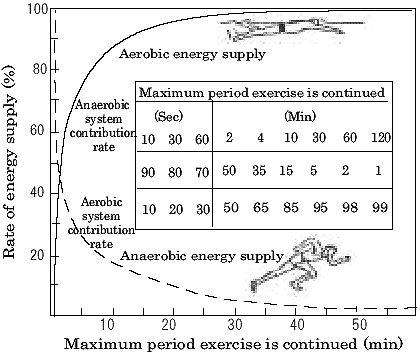
Fig.1 Relative rate of contribution by anaerobic
energy and aerobic energy in maximum exercise at different periods
continued (Astrand, PO and Rohahl, K: Textbook of Work Physiology,
New York, McGraw-Hill Book Company, 1977)
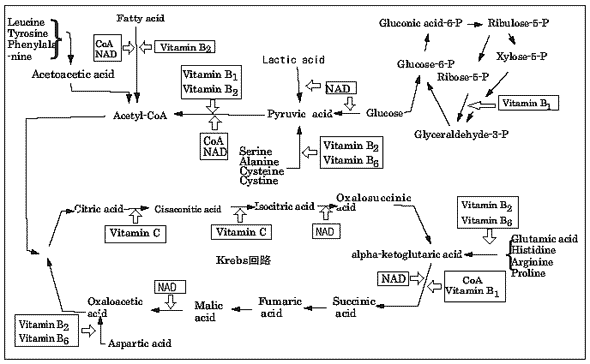
Fig.2 Energy production from glucose, fatty
acids and amino acids and vitamins (Ihara H. and Hashizume N.:
Clinical Sports Medicine, 13, 83 - 89, 1996)
|
|
Effect of Lutein Intake on Serum
and Macular Pigments
Martha Neuringer et al, Invest Ophthalmol Vis
Sci. 2004; 45: 3234-3243
|
|
Purpose
Two types of xanthophylls, lutein and zeaxanthin, are
the major components of macular pigment, and are assumed to
protect the macula from age-related macular degeneration (AMD).
In this study, lutein or zeaxanthin was administered to rhesus
monkeys reared with non-xanthophyll containing feed to record
the changes in macular pigments along time.
Methods
Eighteen rhesus monkeys were reared with feed that contains
no xanthophyll from birth to ages of 7 to 16 years. Then they
were administered with lutein or zeaxanthin by 3.9 micro mol/kg/day
(2.2mg/kg/day) for 24 to 56 weeks (6 animals for each substance).
Serum carotenoid levels were measured using HPLC at the baseline,
4th week, and 12th week of administration period to determine
the density of macular pigments by dual-wavelength reflectometry.
Serum carotenoid level and macular pigment density were also
measured for animals reared with normal feed for stock animals.
Results
<Serum
carotenoid>
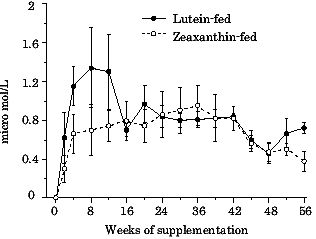
In the group administered with non-xanthophyll
containing feed, lutein and zeaxanthin did not exist at measurable
levels, and the only carotenoid detected in the serum was
lycopene (<0.070 micro mol/L). When lutein or zeaxanthin is
administered to this group, the xanthophyll concentration
in serum increased rapidly for the first 4 weeks to reach
1.14 micro mol/L (range 0.53~1.85) lutein concentration in
the lutein administration group and 0.65 micro mol/L (range
0.19~1.43) zeaxanthin concentration in the zeaxanthin administration
group (Fig.1). The xanthophyll levels in serum exceeded the
levels of the group fed with stock feed by 2 weeks of administration,
and lutein level became approximately 10 times and zeaxanthin
level 10 to 20 times higher. However, increase in xanthophyll
concentration in serum ceased when 12 weeks have passed, and
the total xanthophyll concentration was nearly similar for
both of the administration groups after 16th week.
|
<Macular
pigment density>
Optical density of macular pigments was extremely low after
administration of non-carotenoid containing feed. However,
not only serum concentration increase but also macular pigments
were accumulated after administration of lutein or zeaxanthin.
This result demonstrates that either lutein or zeaxanthin
maintain the mechanism to accumulate macular pigments even
for the retina of a primate matured without xanthophylls.
Thus it is possible that lutein/zeaxanthin intake may be effective
when it is desired that macular pigments be increased in elderly
people with risks of macula luteal-related diseases or in
people under poor dietary environment which caused continuation
of low macular pigment densities.
Though optical density of macular pigments increased for
the first 24 to 32 weeks, further increase was not observed
with consistency for 32 to 56 weeks (Fig.2). The color photograph
of eyeground showed no formation of crystals within the retina
at any point during administration period. This indicates
that it is possible even for a retina which has never been
exposed to macular xanthophyll to absorb xanthophylls when
exposed to high administration levels. On the other hand,
it may lead to generation of crystals instead of such favorable
reaction if a type of carotenoid that does not exist normally
in retina is administered at a high dose.
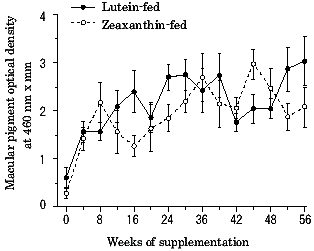 Fig.2
Changes in macular pigment density after xanthophyll intake Fig.2
Changes in macular pigment density after xanthophyll intake
Conclusion
In rhesus monkey, intake of lutein or zeaxanthin lead to
increase in serum xanthophyll and macular pigment levels although
there had been long-term deficiency in xanthophylls for the
entire period since birth. Therefore, it is surmised that
this species is a potential study model for the mechanism
of protection against AMD.
|
Anticancer Activity of EGCG
Inhibition of Vascular Tumor Growth by Epigallocatechin-3-Gallate
(EGCG)
Gianfranco Fassina et al, Clin Cancer Res.10; 4865-4873, 2004
|
It is said that drinking green tea is related to reduction
of incidence for some tumors. The current data suggests
that the main intermediate for this scientific preventive
effect is epigallocatechin-3-gallate (EGCG), which is the
polyphenol detected in dry green tea leaves most abundantly.
Thus we have investigated the effects of green tea and of
EGCG both on a tumor model of highly vascularized Kaposi's
sarcoma (KS) and on endothelial cells in vivo as well as
in vitro. The findings of this study suggest that the green
tea gallate may be used for preventive chemical treatment
of vascular tumors or for the setup as a coadjuvant.
|
|
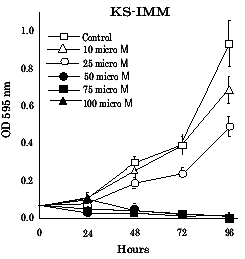
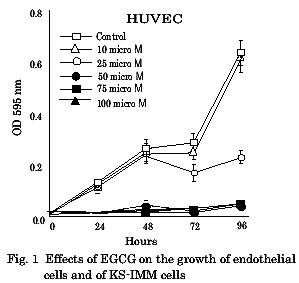
Effects of EGCG on the growth
of endothelial cells and of KS-IMM cells
The effects of EGCG on cellular growth were investigated
first in vitro. The growth of KS-IMM cells was significantly
inhibited for EGCG concentrations of 25 micro M or higher
(Fig. 1 upper panel), and the total number of cells evidently
decreased for EGCG concentrations of 50 micro M or higher.
Similar effects of growth inhibition by EGCG were observed
on human umbilical endothelial cells (HUVEC) with a strong
cytostatic effect seen 72 hours later at 25 micro M of EGCG
(Fig. 1 lower panel, p<0.001).
Effects on apoptosis
Since it was suggested that the effects of EGCG on cellular
growth were potentially either apoptotic or cytotoxic, the
effects of EGCG on apoptosis were
|
investigated. For lower doses
of EGCG administration (10~25 micro M), the effect of EGCG
to induce apoptosis or necrosis was not observed on the
cells of either KS-IMM or HUVEC during 24 hours, whereas
for doses higher than 25 micro M of EGCG, dose-dependent
apoptosis was induced on both KS-IMM and HUVEC cells. The
threshold concentration for inducing the apoptosis seems
to be 50 micro M for both cell lines.
EGCG lowered
the growth of KS tumor
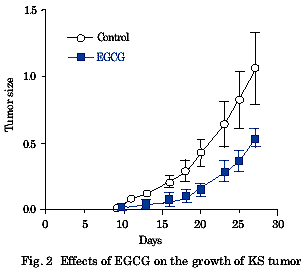
The possibility for EGCG and green tea to inhibit the growth
of vascular tumor cells in vivo was investigated on the
assumption that EGCG inhibits the growth of KS cells and
vascularization. Hypodermic injection of KS-IMM cells, which
are an immortalized KS cell line, into a male nude mouse
develops a highly vascularized tumor. EGCG was orally administered
along with drinking water to the active-drug group every
three days or every other day prior to the hypodermic injection
of the KS-IMM cells. The tumor growth was significantly
lowered compared with the control group to which only drinking
water was administered (p<0.05) (See Fig. 2). Furthermore,
large tumors developed in 90% of the control group, whereas
only slowly developing tumors limited in size appeared in
all members of the active-drug group. Since there were almost
no differences in the body weights of the animals used in
the study, it is suggested that the toxicity of EGCG is
either only limited or absent. The size of the tumors decreased
by about 50% on EGCG-administered mice.
|
|
| |
| |
|
