|
Note of invitation to the 55th
meeting of the Vitamin Society of Japan
Makoto Shimoyama
Chairperson of the 55th Meeting, President of Shimane Medical University
|
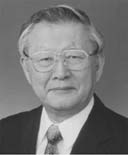
Dr.Makoto Shimoyama |
Introduction
Research on vitamins has advanced in the process of fight against
vitamin deficiency which had raised fear as a disease with unknown
etiology. In the present days when we have entered the 21st century,
in parallel with increasingly greater attention paid to the means
of correcting imbalance between the intake and consumption of energy
as well as to the safety of foodstuffs, great expectations and needs
have grown for the beneficial effects of supplements as a source
of vitamins with an eye toward health maintenance and disease prevention
in industrialized society supported by highly advanced technologies,
giving vitamin research similarly important or more important roles
as compared with those played by past research which had been pursued
to combat vitamin deficiency. It is hoped that the holding of this
meeting will facilitate the contribution of vitamin research to
the promotion of health and longevity in this aging society as well
as to the advances of research in the field of life science.
|
The 55th Meeting of the Vitamin Society
of Japan is going to be held on Thursday, May 29 and Friday, May 30
of 2003 at the WelCity Shimane hall (Izumo Welfare Pension-funded
Hall) and Izumo City Hall in Izumo City, Shimane Prefecture. During
the two days, presentations of the report of the reports on 114 general
topics will be made, and general meeting of the Vitamin Society of
Japan as well as a symposium will be held, and memorial lectures by
the recipients of the Vitamin Society Award and special lectures will
be delivered.
The memorial lectures by the recipients of the Vitamin Society Award
of this year are going to be given by Professor Katsuyuki Tanizawa
at the Institute of Scientific and Industrial Research, Osaka University
under the title of "Discovery of new built-in peptide quinone coenzymes
and their production mechanisms" as well as by Professor Itaru Yamamoto
at the Faculty of Pharmaceutical Sciences, Okayama University under
the title of "Study on the molecular modification of vitamin C and
its properties." In addition, the memorial lecture by the recipients
of the Incentive Award will be delivered by Takanori Yokota, an instructor
at the Faculty of Medicine, Tokyo Medical and Dental University under
the title of "Discovery of, Elucidation of the Developmental Mechanism
of, and Establishment of Treatment Methods for, Familial Idiopathic
Vitamin E Deficiency."
Recently, research on the mechanisms underlying biological reactions
in the body in which NAD (nicotinamide adenine dinucleotide) is involved
has made amazing advances. For example, functions of NAD have become
widely known not only as coenzymes involved in redox reactions but
also as the substrate for ADP ribosylation, a post-translational protein
modification reaction, as well as for cyclic ADP-ribose production,
second messenger regulating calcium mobilization, and a very wide
diversity of ADPribosylation reactions have also become revealed.
On the other hand, research on NAD has shown continuing progress and
has produced new findings, for example, that NAD functions as the
acetyl group acceptor in histone deacetylation and, via the regulation
of chromatin structure, determines the life span of yeast, etc. as
well as that channels exist opening of which is induced by NAD. The
coming special lectures and symposium are planned to focus on such
a wide variety of NAD functions.
More specifically, in the special lectures, Dr. Takashi Sugimura,
an honorary president of the National Cancer Center, and Dr. Danesh
Moazed at Harvard University are going to talk about ADP-ribosyl transferase
of cabbage butterfly as well as about NAD and aging. In the symposium,
lectures will be delivered by Professor Taisei Mori at the Center
for Integrative Biosciences, Okazaki National Research Institute,
Professor Masanao Miwa at the School of Medicine, |
University of Tsukuba, and Dr. Masaharu
Terashima at the Faculty of Medicine, Shimane Medical University,
about the NAD-mediated regulation of calcium channel activity, regulation
of cellular functions through poly ADP-ribosylation as well as mono
ADP-ribosylation in vertebrates. These lectures will get you more
deeply interested in a wide variety of in vivo functions of vitamins.
This will be the first meeting of the Vitamin Society of Japan held
in the Sanin region, which can be said to be, in a sense, a place
where medicine was first introduced in Japan in light of a Japanese
myth of white rabbit in Inaba (old name of eastern part of Tottori
Prefecture) contained in "Kojiki" (one of the oldest books in Japan
containing legendary stories of old Japan). According to "Kojiki,"
Ookuninushi-no-mikoto (the god of marriage and good luck) gave a wounded
(skinned) rabbit of Inaba a tip for healing the wound. In the Izumo
Taisha shrine dedicated to Ookuninushi-no-Mikoto (a Shinto deity),
remnants have been found of a sacred central pillar (which is called
shin-no-mihashira in Japanese, and is presumed to have been made up
of three component pillars) to support the original building of Main
Hall which, according to currently existing documents, had been a
gigantic edifice reaching a height of as much as 48 meters. Moreover,
many of you may remember the news of the excavation of as many as
358 copper swords in the Koujindani remains as well as the discovery
of 39 bell-shaped bronze vessels (called "Doutaku" in Japanese, which
are supposed to have been put to some ceremonial use) in the Kamoiwakura
remains. In commemoration of the holding of the meeting of the Vitamin
Society of Japan in the Izumo area, which is the motherland of ancient
Japanese culture and myths, a cultural lecture under the title of
"The Romance of Ancient Izumo" is planned to be delivered on the first
day of the meeting by Mr. Yasutaka Hayami who is a scholar of ancient
history. In addition, in the social gathering following the lecture,
attractions with specificity to the birthplace of myths are to be
offered. Please don't miss them. Furthermore, after the meeting has
finished, you will be able to enjoy visiting areas mentioned in ancient
myths to conjure up images of the remote past as well as taking a
walk around the Izumo area rich in verdure to commune with the beauty
of nature in early summer. Such pleasures accompanying a meeting of
the Vitamin Society of Japan can be experienced only when such a meeting
is held in such a region with a profound history as the Izumo region.
We would be delighted to see many of you participate in the coming
meeting for the presentation of the latest results of vitamin research
and discussion in the Izumo region, which is a birthplace of Japanese
myths. |
|
The Latest Results of, and Trend in, Research
on Catechins
-From the 18th Lecture Meeting of the Tea Scientific Research
Group of Japan-
Isao Tomita
Prof. of the Shizuoka Sangyo College & President of the Tea S. R.
G. of Japan
|
|
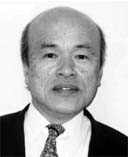 Prof.
Isao Tomita Prof.
Isao Tomita
In recent years, tea catechins (flavan- 3-ol derivatives)
have attracted people's attention. This is because reports
have been successively made that catechins, especially (-)-
epigallocatechin gallate (EGCG; for its chemical structure,
see Figure 1), exhibit potent free-radical scavenging and
reactive oxygen scavenging effects at least in in-vitro experimental
systems and that results of experiments using a wide variety
of animal models of lifestyle-related diseases such as cancer
and arteriosclerosis have indicated that catechins may have
prophylactic effects on such diseases, in addition to antibacterial
and deodorant effects. A wide range of beneficial effects
of catechins in terms of sanitation/hygiene in daily life
and disease prevention have been reported so far and are summarized
in Table 1.
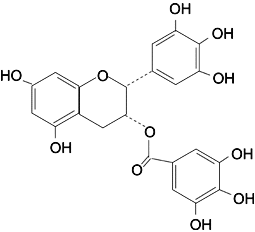
Figure 1. Chemical structure of catechin
(EGCG)
Table 1. Effects of catechins
antioxidative effect, antimutagenic effect, anticancer effect,
serum cholesterol lowering effect, antihypertensive effect,
hypoglycemic effect, antithrombotic effect, anti-arteriosclerotic
effect, antibacterial effect, deodorant effect, anti-caries
effect, antiviral effect, intestinal microbial balance improving
effect, and antiallergic effect
The Tea Scientific Research Group of Japan has called an
annual meeting in March. This year, the 18th meeting was held
on March 13 at the Bouquet Tokai hall. In the part of general
lectures, reports was made on the deodorant, antibacterial
and antifungal effects of catechins in their application to
refrigerators (cooling fans) and air-conditioners (filter,
fans, etc.) (Hunayama et al., Hitachi Home & Life Solutions,
Inc.; Takimoto et al., Taiyo Co., Ltd.) and the mechanisms
underlying such effects, as well as on the sustained release
of catechins when they are mixed with ceramics (to form catechinceramic
hybrids) and further with L-ascorbic acid 2-phosphate magnesium
(Hatayama et al.; Chisso Corporation). While beneficial effects
of catechins have been confirmed in both of these cases, in
the application to air-conditioners in particular, catechins
have been reported not only to exert deodorant effect on the
odor of ammonia, etc. but also to effectively remove gaseous
formaldehyde, which is deemed to be a chemical causing sick
house syndrome.
In fresh raw tea leaves treated anaerobically, increase in
gamma amino butylic acid (GABA) is seen, and by utilizing
this phenomenon, so-called "Gabaron-Cha" (tea rich in gamma
amino butylic acid) is manufactured. Tsuru et al. reported
about the production of a tea drink having sweet floral aroma
by utilizing L. brevis-fermented tea extract. Moreover, reports
have been made about the antiproliferative effects of extracts
of Goishi cha (a kind of fermented tea) and Awa Bancha (a
kind of anaerobically fermented tea), which have been traditionally
produced in the Shikoku region, on human leukemia cells (U937)
(Sazuka et al.; Kochi University of technology) as well as
about the in-vivo kinetics of a catechin (epigallocatechin
gallate: EGCG) following its oral administration to humans
(D. Raederstorff et al.; Roche Vitamins Ltd., Basel, Switzerland).
The group of Dr. Raederstorff in particular reported detailed
data on change over time in blood concentration of EGCG in
volunteers receiving the single (EGCG 50-1,600 mg) or repeated
(EGCG 200-800 mg; 10 days) oral administration of a capsule
containing 94% EGCG prepared from tea extract. Their report
revealed that blood EGCG concentration increased dosedependently
to reach a maximum within 1-2 hours after the administration
and that its elimination half life is 4-5 hours, indicating
good tolerability and low risk of accumulation.
The Tea Scientific Research Group of Japan invites applications
from those who would like to obtain research grants (In the
last fiscal year, applications were invited during the period
from June 1 to July 31). Out of 17 applicants of the last
fiscal year, 5 had been accepted and reported the results
of their research in the previous meeting lecture meeting.
The names of the lecturers and the themes of their lectures
are as follows: All of these lectures dealt with up-to-date
and interesting information.
|
1. Development of Methods for distinguishing
the varieties of commercially available tea (Mr. Ujihara;
National Institute of Vegetable and Tea Science [NIVTS], National
Agricultural Research Organization [NARO])
2. Confirmation of Fundamental Chemical
Properties of Tea Catechins Affecting Their Functionality
(Mr. Tanaka; Graduate School of Biomedical Sciences, NagasakiUniversity)
3. Elucidation of Environmental Factors Affecting Oxalic
Acid Synthesis in Tea Leaves and the Development of Teawith
Low Oxalic Acid Content (Mr. Morita; Faculty of Agriculture,
Shizuoka University)
4. Research on the Inhibitory Effects of Theanine, a Component
of Tea, on Glutamic Acid-induced Cell Death of neurons in
the cerebral cortex and on Molecular Mechanisms Underling
the Effects (Mr. Nagasawa; Kyoto Pharmaceutical University)
5. How are the floral aroma of oolong tea and black tea formed?--Elucidation
of the Mechanisms Underlying Tea Aroma Formation Mediated
by Beta-primeverosidase-- (Mr. Mizutani; Institute for Chemical
Research, Kyoto University)
In addition to these lectures, two special lectures, the
highlights of the meeting, were given under the following
titles:
1. Cell Growth Regulation and Long-term
Storage of Organic Tissues at Room Temperature with the Use
of Green Tea Polyphenols (Mr. Gen; Institute for Frontier
Medical Sciences, Kyoto University)
2. Inhibitory Effects of Tea Catechins on Oxidative DNA Damage
(Mr. Kaneko; Tokyo Metropolitan Institute of Gerontology)
Due to limitations of space, the details of these lectures
will be omitted here. Briefly, findings reported in these
lectures in general seemed to have reflected the physical
properties of catechins (solubility in both water and oil)
which are distinguishable from those of vitamins E and C.
Needless to say, catechins are not vitamins directly involved
in the maintenance of life, but are "health factors" deeply
influencing the maintenance of human health. In recent years,
green tea prepared from the leaves of varieties of tea containing
epigallocatechin-3-(3''-O-methyl) gallate, i.e., so-called
methylcatechin, including Benifuki(originally bred for black
tea and semi-fermented tea), has been reported to have anti-allergic
effects and has gained the spotlight (About this, Mr. Banri
Yamamoto has already talked in detail in the 17th meeting
of the Tea Research Group of Japan). Interestingly, the content
of methylcatechin considerably varies with the variety of
tea. Recent research revealed that, other varieties than Benifuku,
including Benifuji, Benihomare, Yamakai and Okumidori contain
about 0.4-1.3 g of methylcatechin per100 g of dried leaves,
while the Yabukita variety, which is the most popular tea
variety for green tea, contains no methylcatechin (RYOKUCHA
Vol. 6, p.39-40, 2003).
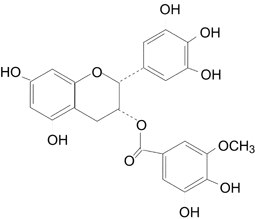
Figure 2. Chemical structure of Methylcatechin(EGC3"MeG)
We have entered the days where tea production
with an eye toward body-modulating functions as well as aroma
and taste, which have been thought much of in the processes
of tea cultivation and development of tea products, is sought.
Furthermore, studies on polyphenols, which have been performed
mainly on catechins (EGCG in particular) and have produced
excellent results, will make further progress by assimilating
the achievements produced in related research fields, and
polyphenols, on the back of vitamins, will come to universally
accepted as "health factors" in the near future.
In closing, I want to mention the individuals who had taken
the initiative in scientific research on tea for many years
and received an honorary award for efforts yet to be widely
recognized from the Tea Scientific Research Group of Japan
on the day of the meeting. The names of the three recipients
are as follows: Mr. Masayuki Nakagawa (advisor to the Japan
Tea Manufacturing Technology Society and former director general
of the National Institute of Vegetable and Tea Science, Ministry
of Agriculture, Forestry and Fisheries), Mr. Shigeki Konishi
(professor emeritus at Shizuoka University), and Mr. Syuuichi
Takeo, Central Research Institute, Itoen, Ltd. (former director
of the Department of Tea, National Institute of Vegetable
and Tea Science, Ministry of Agriculture, Forestry and Fisheries.
|
|
|
|
| EGCG the most abundant
catechin in green tea: Pharmacokinetic parameters in humans
|
|
Currently, epidemiologic studies on the preventive effects of
green tea on heart diseases and cancer are in progress. In addition,
anti-obesity effect of green tea has also captured attention recently.
Such beneficial effects of green tea arethought to derive from catechins,
especially EGCG, that are contained in tea leaves. It has been suggested
that EGCG, which is most abundantly found in green tea extract,
exerts various beneficial effects including antioxidative, anticancer
and antihypertensive effects. In spite of the fact that findings
indicative of beneficial effects of catechins have been obtained,
concerning the kinetics of EGCG in humans, only limited data have
been obtained and studies focusing on other tea catechins than EGCG
(such as (-)-epicatechin [EC], (-)epigallocatechin [EGC] and (-)epicatechin
gallate [ECG]) have been mainly performed. In the 18th lecture meeting
of the Tea Scientific Research Group of Japan, however, a group
of Roche Vitamins Ltd. (D. Raederstorff et al.; Roche Vitamins Ltd.,
Basel, Switzerland) reported the results of a study focusing on
the kinetics of EGCG in humans. The details of the report will be
discussed below.
In the meeting, data on change over time in plasma EGCG concentration
in healthy volunteers receiving the oral administration of "TEAVIGOTM"
containing EGCG with a purity of 94% on average, which has become
successfully extracted from green tea leaves by using patented and
innovative technology of Roche Vitamins Ltd.
|
Materials and Methods
Single oral administration
Subjects: 60 healthy white male volunteers aged 18-44
years
Dose levels and dosing regimen: Single doses of 50 mg,
100 mg, 200 mg, 400 mg, 800 mg and 1,600 mg of
TeavigoTM were orally administered following 10-hour
fasting
Rsult
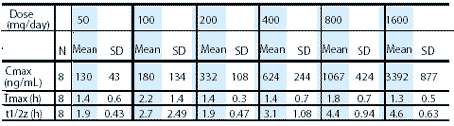
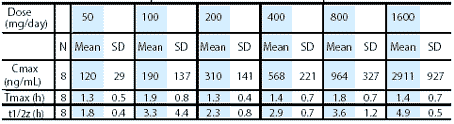
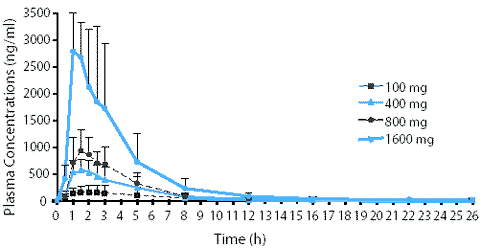
Data on the profile of plasma concentration of free and
total EGCG (free plus conjugated EGCG) are given in
Tables 1 and 2, and data on changes over time in
plasma concentration following administration are
shown in Figure. |
|
Table 1: Plasma-kinetic parameters of total
EGCG in plasma
|
Table 2: Plasma-kinetic
parameters of free EGCG in plasma
|
|
Discussion
The results of this indicate show that EGCG exhibits good tolerability
profile in humans even when administered in the amount (1,600 mg)
that cannot be taken through usual use of green tea leaves and that
EGCG has short elimination half-life, suggesting lower risk of its
accumulation in the body.
In addition, in animal experiments, it has been confirmed that
absorption of EGCG is delayed when it is taken with feed. Furthermore,
it has also been shown that a large fraction of EGCG in the plasma
is present in its free form, not as glucuronide or sulfate conjugates.
|
|
Fig. Mean Plasma Concentrations-Time Curves
of EGCG as total form (n=8 in each dosage group)
|
|
|
|
Improvement in visual acuity in
patients with age-related cataract through the ingestion of lutein
B.Olmedilla et al. Nutrition,19:21-24,2003
|
The prevalence of cataract increases with advancing
age. The disease causes visual acuity deterioration and may lead to
decreased activity of the elderly. The onset of cataract is presumed
to be triggered by various factors related to progressive oxidative
damages to the lens. Such oxidative damages to the lens may be prevented
by the free-radical scavenging effect of antioxidants such as carotenoids
and vitamin E. In fact, it has been suggested that long-term ingestion
of vitamin C or E as well as ingestion of a large amount of vegetables
with high lutein content, for example, may be associated with decrease
in the risk of developing cataract.
Lutein and zeaxanthin are present in normal human retina, macula
and crystalline lens, which enables explanation about the preventive
effects of those carotenoids against cataract formation from biological
point of view. As a matter of fact, macular pigment density decreases
with advancing age. In addition, it has been suggested that dietary
intake of lutein and zeaxanthin is positively correlated to, for example,
serum concentrations of these carotenoids, macular pigment density,
as well as visual function.
In this study, investigation was conducted into the effects of long-term
ingestion of antioxidants (lutein and alphatocopherol) on their serum
concentrations and visual function in patients with cataract. |
|
Study design: double-blind randomized
study
Subjects: 15 patients given
the diagnosis of age-related cataract
Dose levels : Lutein group
(n=5):15mg alpha-tocopherol group (n=5):100mg Placebo group
(n=5): corn oil 500mg ingested three times per week
Study duration :two years
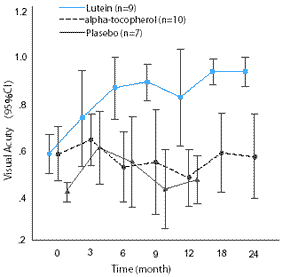
FIG. 1. Changes in visual acuity of patients
with cataracts during the supplementation study (eyes were
assessed individually). CI, confidence interval.
|
Results
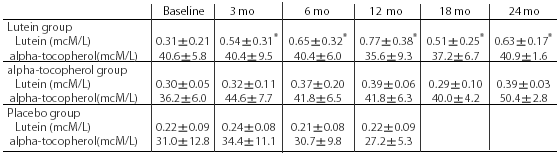
In the lutein and alpha-tocopherol groups, increase in the
serum concentration of respective antioxidants was observed.
In those groups, serum concentrations of lutein and alpha-tocopherol
reached the maximum levels 3-6 months after the initiation
of ingestion, and remained at the level thereafter (Table
1). Serum biochemical examinations in the subjects did not
reveal any adverse reactions. Although the planned duration
of this study was 2-3 years, no improvement in visual function
was noted especially in the placebo group, resulting in discontinuation
of study participation by many subjects due to the necessity
of cataract surgery. After the ingestion of antioxidants in
this study, visual acuity was improved only in the lutein
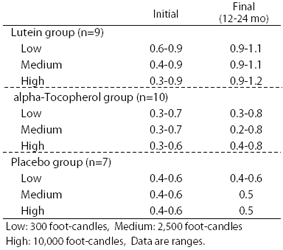
group (Figure 1). In the lutein group, results of glare test
(a test quantitatively evaluating the effects of stimulated
glare on visual function) were also improved as compare with
baseline (Table 2). During the study period, cataract progression
was delayed in 4 out of 5 patients in the lutein group, 3
out of 5 patients in the alpha-tocopherol group, and 1 out
of 5 patients in the placebo group.
Table2 Changes in Visual Function Parameters
in Patients with Cataracts at Supplementation
|
|
Table1 Changes in Serum
Lutein and alpha-Tocopherol Concentrations with Supplementation in
Patients with Cataracts
* P<0.005 |
| |
| |
|
