Upon Sponsoring the 52nd Conference of the Japan Vitamin Society
Prof. Yoshinori Seino,
Okayama University School of Medicine, Department of Pediatrics 
Introduction
       Historically, studies on vitamin D in Japan have presented remarkable achievements. From Dr. Umetaro Suzuki who discovered vitamin B1 to Dr. Tatsuo Suda who discovered that vitamin D induces differentiation and Dr. Shigeaki Kato who became the world's first researcher to produce the VDR (vitamin D receptor) mutant mouse (VDRKO mouse), the vitamin D studies in Japan have always attracted the world's attention.
       This conference will focus on the results of vitamin D studies which have recently made remarkable progress. It will also feature a special lecture on minerals, a subject attracting attention from co-medical members, who have been rapidly increasing in number in recent years. We are confident that the contents of this conference will come up to the expectations of participating members.

       It is our honor that the 52nd Conference of the Japan Vitamin Society will be held in Okayama. The last conference of this society held in Okayama was the 12th Conference, held from May 9th to 11th in 1960, and it has been 40 years since then. The late Eiji Hamamoto, Professor Emeritus of Pediatrics at Okayama University, chaired that conference. Professor Hamamoto was the predecessor of my predecessor at my laboratory. While I specialize in vitamin D, the Professor specialized in water-soluble vitamins.
       Studies on vitamin D have made remarkable progress in recent years. Vitamin D is activated in the kidneys, and the activating enzyme was cloned by the team led by Dr. Shigeaki Kato. It is worthy of special mention that most of the recent findings on vitamin D have been discovered by Japanese researchers.
       The 52nd Conference will be held on Friday, May 19th and Saturday, May 20th at Tokyu Hotel Okayama. The morning of the first day will be spent on general lectures on vitamins D, B6, and C. The whole of the second day will be spent on vitamin A, carotenoid, vitamins E, B1, B2, B12, biotin, nicotinic acid, biofactors, and so on. In the afternoon of the first day, the conference will be limited to a single conference room which will be devoted to the special lectures and the Society Prize lectures, etc.
       A special lecturer will be invited to this conference: Anthony W. Norman, Professor of Biochemistry at the University of California. He is the president of the Vitamin D Workshop, the world's most authoritative medium of presenting study results on vitamin D. This writer has had the honor of being invited to each conference of the Workshop as a guest lecturer. The special lecture by Prof. Norman will be simultaneously interpreted into Japanese, in the hope that many members will be encouraged to join the audience.
       Another special lecturer invited to this Conference will be Professor Norihiro Yasumoto of Sugiyama Jogakuen University. As you know, Prof. Yasumoto specializes in minerals. Currently, conventional nursing schools, schools for laboratory technicians, and schools for radiological technicians are being reorganized into many health faculties and nursing colleges with a close relationship to medical schools. Considering the rapid increase in the number of undergraduate and graduate students at such co-medical schools, I think the Vitamin Society has an important role to play in providing these students with opportunities to present their research results. Since these people who specialize in co-medical fields seem to be very interested in minerals, we decided to choose this subject as the theme of this special lecture.
       There are three Society Prize lectures this year: "A Study on New NAD(P) and Vitamin B6 Enzyme of Bacteria" by Prof. Haruo Misono of the Faculty of Agriculture of Kochi University; "Molecular-Biological Elucidation of the Functional System of Vitamin D on the Molecular Basis" by Prof. Shigeaki Kato of the Institute of Molecular and Cellular Biosciences of Tokyo University; and "A Study on Metabolic Regulation and Action of Vitamin D in the Field of Pediatrics" by Assistant Prof. Hiroyuki Tanaka of the Faculty of Medicine of Okayama University. Remarkable study results will be presented in each of the lectures; I hope you will look forward to listening to them.
As I have described above, at this Conference the special lectures will be on subjects which have not been very common. We hope this will contribute to the progress of the Japan Vitamin Society in the future. 


AMD and Lutein
(from Nutritional and Environmental Influences on the Eye) 


What is AMD (Age-related macular degeneration) ?
       AMD is a devastating degenerative condition of the macula and in the western world it is the main cause of irreversible blindness among the elderly. It occurs in two forms: a "dry" atrophic form, and a "wet" form characterized by the presence of neovascularization causing fluid accumulation and eventually loss of sight due to hemorrhagic maculopathy. AMD is significantly associated with increasing age. In the Blue Mountain Eye Study, it was present in 1.9% of the overall population; it was absent below 55 years of age, but present in 18.5% of those aged †85 years. Distributions were similar in the Framingham Eye Study, Beaver Dam Study, and in the Finish Oulu county study.
       While Caucasians have long been known to be at greater risk, a recent study found wet AMD to be rare in Hispanic vs non-Hispanic whites, probably due to an important genetic determinant. Other studies have reported a family history of the condition as a risk factor.
       Other AMD susceptibility variables reviewed in include gender: women are at greater risk than men. This may in part be related to estrogen levels since the frequency of the wet form is reduced in postmenopausal women on estrogen-only replacement therapy. Cardiovascular disease, especially factors relating to hypertension, are also linked to AMD, as are high levels of HDL cholesterol, cigarette smoking, exposure to sunlight and low ocular melanin (melanin itself being both a generator and potent quencher of free radicals). The latter three risk factors are of particular relevance in oxidative situations.
       The etiology of AMD is recognized as being multifactorial. However, the concept of oxidative insult as one of the primary events is well substantiated. The retina is highly active metabolically with a respiratory quotient near unity and a much higher blood flow than other tissues. In such an environment, the oxidative nature of retinal functions, high oxygen tension, and simultaneous presence of light can ultimately produce singlet oxygen and numerous free radicals with the potential to induce peroxidation of polyunsaturated fatty acids, including that of docosahexaenoic acid, the most highly unsaturated naturally occurring fatty acid and major lipid constituent of vertebrate photoreceptors.
       It is also possible that the selective distribution of the retinal carotenoids (and possibly vitamin E) impinges on susceptibility to AMD. As pointed out by Snodderly, the foveal crest and immediately surrounding retina are the first areas to show degenerative changes in AMD. They are the site of maximal age-related rod photoreceptor loss even in healthy retinae, and of the gradual accumulation of lipofuscin, a product of lipid peroxidation. Snodderly suggested that the relatively low concentrations of both vitamin E and retinal carotenoids in the foveal crest (in contrast to the center of the fovea) may make it particularly susceptible to the development of AMD. 

Epidemiological Studies
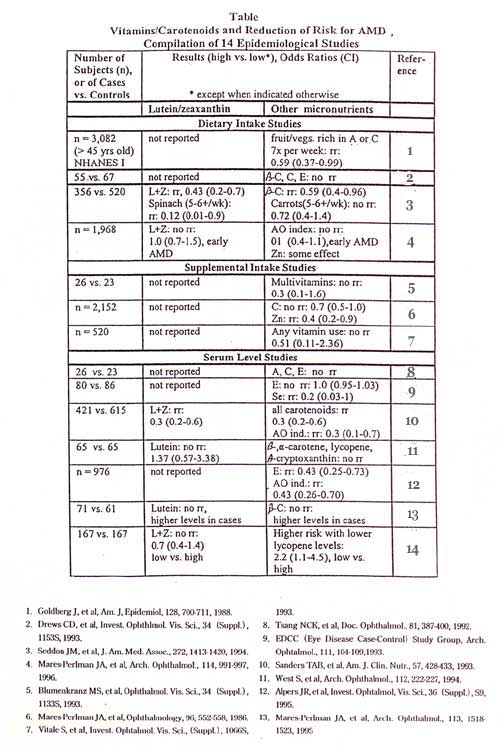
       Although there is recently increasing interest in epidemiological studies of carotenoids and their effects, only a few studies as yet have been so specific as to deal with the issue of lutein and zeaxanthin with respect to their potential to reduce the risk of diseases of the macula such as AMD.
       Those studies either studied the effect of dietary or supplemental intake. However, because of the current limited availability of lutein and/or zeaxanthin supplements, no supplemental intake studies for these carotenoids are reported. Another type of epidemiological studies evaluated the correlation of serum values of the micronutrients in question with risk of AMD. In the follow table those studies are listed giving information whether lutein or zeaxanthin or other micronutrients have been studied. Already in 1985, nutritional status had been proposed as a potential risk factor in AMD. Subsequently, results from the first epidemiological investigation of the correlation of nutritional factors and the risk of AMD were reported. 


Oral Contraception and Nutrition No.2
(from Nutritional Concerns of Women)

Psychoaffective Disturbances
       There exists a link between depressive mood changes and abnormalities in tryptophan metabolism. First, a direct inhibition of cerebral uptake of tryptophan by the synthetic steroids could reduce the amount available for 5-HT synthesis. Second, 5-hydroxytryptophan decarboxylase (another B6-dependent enzyme), involed in this synthesis, may be susceptible to competition for pyridoxal phosphate by estrogen conjugates. Third, a disturbance in liver tryptophan metabolism during oral contraception may cause, indirectly, depression through changes in the level of brain serotonin, as already mentioned in the previous section. Our discussion will focus on this metabolic cerebral alteration which has been the most explored.
       The synthetic estrogens (and the 50-fold increased endogenous estrogen secretion during pregnancy), by stimulating TPase, contribute to the diversion of tryptophan metabolism from its minor cerebral serotonin pathway to its major kynurenine-niacin pathway in the liver. This shift of tryptophan metabolism toward the kynurenine-niacin pathway, evidenced by increased urinary xanthurenic acid excretion, is at the expense of serotonin synthesis. The reduced 24-h urinary output of 5-hydroxyindolacetic acid (5-HIAA, end product of 5-HT) has been demonstrated by Shaarawaway et al.
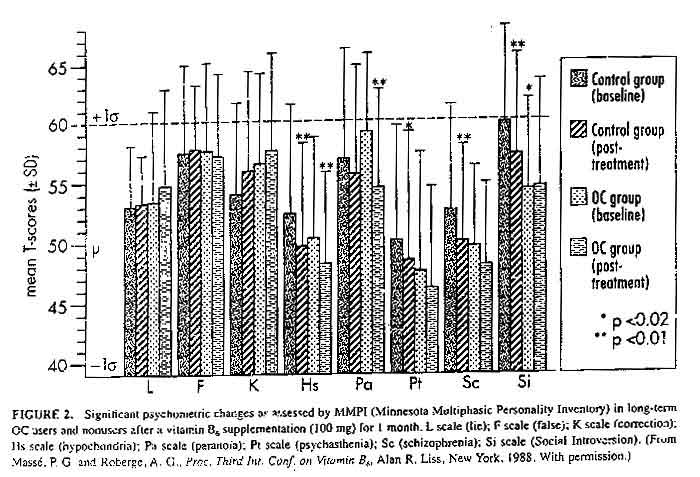
       Studies carried out on the psychological side effects of hormonal conception have focused on the depressive syndrome, although other various emotional states do occur. In fact, psychological side effects related to OCs use are multidimensional in nature. The recent literature suggests that depression associated with OCs may differ significantly from non-organic major depressive episodes. Depression has been recognized as a complication of estrogen-progestogen contraceptives, although only a small number of women develop this syndrome. Its incidence is still disputed, but it probably occurs in about 5 to 6% of women. In agreement with Kutner and Brown's study, Masse and Roberge have been unable to support a relationship between oral contraception and depression. The depression scale of OC users, when administered by MMPI (Minnesota Multiphasic Personality Inventory) after a long-term use (4 years on average) of a relatively low-dose (30ƒÊg ethinyl estradiol) combined preparation (Figure), was identical to that of control nonusers. None of the OC users suffered depression. Our recent specific study on TriphasilR also revealed no psychoaffective changes at an early stage of utilization, e.g,. at the sixth menstrual cycle (unpublished data). The strength of the last three aforementioned studies lies in the use of an objective and comprehensive rating instrument such as MMPI 

Treatment of hypertension with ascorbic acid
(from THE LANCET Vol.354, Dec.11, 2048-2049) 


In a randomised, double-blind, placebo-controlled study we showed that treatment of hypertensive patients with ascorbic acid lowers blood pressure. Further studies of ascorbic acid to treat hypertension, with clinical endpoints, are warranted.
Experimental studies of essential hypertension suggest that increased production of reactive oxygen species may play a part in aetiology. Epidemiological studies show that dietary intake of ascorbic acid correlate inversely with hypertension and its clinical sequelae. We examined the effect of ascorbic acid treatment on blood pressure.
       Otherwise healthy patients with hypertension (a history of antihypertensive treatment or untreated diastolic blood pressure >90 mmHg) were recruited by advertisement and provided informed consent. Exclusion criteria included coronary artery disease, diabetes mellitus, uncontrolled hypertension (diastolic blood pressure >110 mmHg), heart failure, and use of antioxidants or oeatrogens within one month. Patients fasted overnight, and, if applicable, did not smoke for 24h before two visits, one month apart. Short-acting and long-acting vasoactive medications were withheld for 12 and 24 h, respectively, before both visits. Otherwise, antihypertensives were continued throughour the study period.
       45 patients were enrolled. Three from each group did not return for follow-up. Baseline characteristics were balanced (table). As shown in the figure, systolic blood pressure in the two groups was similar at baseline and after acute treatment: 1 month of ascorbic acid treatment decreased systolic blood presure (mean 155 [SD 22] to 142 [16] mm Hg, p<0.001), whereas placebo had no effect. This difference between treatments was significant (p=0.03). Mean blood pressures were similar at baseline and after acute treatment. However, after 1 month, ascorbic acid decreased mean blood pressure from 110 (12) to 100 (8) mm Hg, p<0.001, and the effect was significantly different from placebo (p=0.02). Diastolic blood pressures were similar at baseline and after acute treatment. After 1 month, ascorbic acid decreased diastolic blood pressure, though this response was not significantly different from placebo (p=0.24). Heart rate was not affected by treatment, suggesting that there was no neurohormonal activation.
       Plasma ascorbic acid concentrations, as measured by HPLC, were similar in both groups at baseline, and increased within the physiological range (50 [12] to 149 [51] and 99 [33] ƒÊmol/L at 2 h and 1 month, respectively, p<0.001). There was an inverse correlation between the change in mean blood pressure and the change in ascorbic acid concentrations (r=-0.39, p<0.03). 
       This study shows that long-term ascorbic acid treatment reduces blood pressure in patients with hypertension. This reduction was of similar magnitude to that predicted by previous population-based and preliminary intervention studies. The mechanism for the reduction remains undetermined. High-dose intra-arterial ascorbic acid may ameliorate endothelial dysfunction in hypertensive patients, although we found that ascorbic acid treatment ha no effect on systemic markers of nitric oxide bioactivity, or prostacyclin production. There also was no evidence that ascorbic acid reduced lipid peroxidation and production of vasoconstrictor F2 isoprostanes (8-epi-prostaglandin-F2). However, these systemic markers are limited because they may not accurately reflect events in the vascular wall.
       Although confirmation of these findings in larger, longer studies is required, the present study suggests that 500 mg of ascorbic acid daily is useful for blood pressure control in patients with hypertension.


Approach of the US Food and Nutrition Board to 
daily nutrient requirements
An extract from 'Report on a Workshop organized by the European Academy of Nutritional Science (EANS) and TNO Food and Nutrition Research Institute, 11 December 1998, Brussels'
(Eur. J. Clin. Nutr (1999) 52, 786-791) 


Introduction
In 1992, the Scientific Committee on Food (SCF) of the European Community expressed its opinion on nutrient and energy intakes for the European Community, at that time twelve Member States. The report provided nutritional recommendations to be used for different goals, including nutrition labeling and community programs on research and nutritional aspects. Excessive intakes were only discussed briefly. Experts of several Member States did not share the recommendations expressed by the SCF. National recommendations for daily nutrient requirement were issued by Member States in 1993 and thereafter, for example by Italy, Spain, the Nordic countries, while at present national recommendations are in preparation (for example, Germany, Austria, Switzerland, France, The Netherlands). However, the development of a (new) concept and of guidelines with respect to the safety and upper levels of intake of these nutrients was found to be necessary because the current activities regarding harmonization on EU food legislation for vitamin and mineral supplements, and the addition of these essential nutrients to food. Therefore, the European Communities may consider a new assessment of the 1992 recommendation timely and appraise new scientific evidence and insight in nutrients and their function. A similar discussion had already started in the US and Canada. After preparatory workshops organized by the Food and Nutrition Board (FNB), the Institute of Medicine (National Academy of Science, USA) installed a Standing Committee on the Scientific Evaluation of Dietary Reference Intakes (DRIs), chaired by V.Young. Expert panels were charged to review the scientific development regarding groups of nutrients, and two additional subcommittees were formed, one on Upper Reference Levels of Nutrients (chaired by I.Munro) and one on the Use of DRIs (chaired by S.Murphy). The first tow panels have issued prepublication reports: 'Vitamin D, calcium and related minerals' (1997) and 'Folic acid and other B-vitamins' (1998). To understand and discuss the concepts and rationale behind the FNB approach and to facilitate discussions between European experts from academia, industry and regulatory authorities, the European Academy of Nutritional Science (EANS) and TNO Nutrition and Food Research Institute organized this workshop (December 1998). In this workshop members of the FNB DRI Subcommittee on Upper Reference Levels of Intake, and from the B-vitamins Expert panel gave an overview on the concept and activities in the USA, while European experts presented an overview on the past and current activities in Europe. In this paper, the presentations and resulting discussions are summarized. 

General concept and approach of the US Food and Nutrition Board
(introduced by Prof. Vernon Young)
       In the USA, the main reason for a revision of the recommended dietary allowances (RDAs) (latest revision 1989) was the apparent evolution in the application of RDAs. RDAs are those levels of intakes judged by the FNB to be adequate to meet the known nutrient needs of practically all healthy persons. Thus, RDAs were to be applied to groups of healthy people and not individuals, and therefore set at levels that exceed the needs of most individuals to encompass the individual variability in nutrient requirements. Especially, the consideration of reduction of risk of chronic disease asn a criterion for adequacy of intake is new provided sufficient data exist on efficacy and safety. However, incorporating the latter criterion appeared rather difficult of lack of sufficient data on several topics, such as the specificity of effects as related to the intake of a single nutrient, dose-response relationships, information on the variability of the effective dose and the interaction between nutrients. Another problem appeared to be the insufficient information available for several subgroups such as adolescents and children. In developing DRIs, the criteria to assess adequacy are of paramount importance. When international harmonization of recommended intakes is pursued, this is one of the essential elements to agree upon. 

Case illustrations for upper tolerable levels of intake - vitamin B6, folic acid and niacin
(introduced by Prof. Robert Russell)
       The 'NRC format' for risk characterization for nutrients has recently been applied to the B-vitamins. 
Vitamin B6: The critical effect level on which the tolerable upper intake was based was sensory neuropathy. For this critical end point, a NOAEL of 200 mg/day was identified and an uncertainly factor of 2 was selected because of the small number of studies available which used doses of pyridoxine less than 500mg / day. Thus, an upper tolerable level of intake of 100mg / day was obtained for vitamin B6.
Folic acid: The critical adverse effect indicator used was precipitation or exacerbation of neuropathy by folic acid in vitamin B12 deficient individuals, although there is only limited, but suggestive evidence. It is important to note, that the upper tolerable level of intake was set not for food folate but rather for synthetic folic acid. Due to lack of data from the literature, the LOAEL rather than the NOAEL was used as a basis. A lowest observed effect level of 5mg of folic acid was derived from 100 reported cases of folic acid treatment in dosages of 5mg or more causing neurologic progression in patients with vitamin B12 dificiency. However, the masking of a vitamin B12 deficiensy state by folate must be considered as lack of appropriate neurological examination of the patient. An uncertainty factor of 5 was used based on the severity of the possible neurologic complications (erring on the side of safety) and because of the fact that LOAEL rather than a NOAEL was used. Thus, the tolerable upper level of intake for adults was set at 1 mg / day for synthetic folic acid. However, ongoing studies on cardiovascular risk prevention use daily supplements of 2.5 mg folic acid, which is higher than the present UL. In the case where the results of these studies are positive, the UL for folic acid will certainly need to be re-considered. Another approach to risk characterization in this case is to start from the level of food fortification. Mandatory folic acid fortification in grain cereals in the USA is currently 140 ƒÊg/ 100g cereal. According to the food guide pyramid the upper level of cereal consumption is 11 servings/day, leading to a supplemental intake of folic acid of 440ƒÊg/day. Therefore, the intake of synthetic folic acid is likely to exceed 1 mg/day only in combination with supplement use.
Niacin: Most of the data on adverse effects from niacin are from studies involving patients with high lipid levels who were treated with phamacological preparations of nictinic acid. The most sensitive but benign adverse effect reported is flushing, resulting either in withdrawal from treatment or a change in the dosing pattern. Using this critical effect, a LOAEL of 50 mg/day was derived from the available database. However, the uncertainty factor chosen was smaal (1.5) because of the transient and rather benign nature of the flushing effect; thus, the tolerable upper level of intake for niacin was defined as 35 mg/day.

The situation in Europe
(introduced by Prof. Ruud Hermus and Dr A Somogyi)
       Contrary to the situation in the USA, European countries usually have their own national intake recommendations for energy and nutrients apart from the SCF recommendations expressed in 1992 (SCF Report, 1993). There are large differences in recommendations between countries. The recommended intake values from different countries are sometimes based on original scientific data reviewed by expert committees, in other cases on a review of the recommendations from other national or international expert groups, or on a combination of both approaches. Secondly, the starting point for setting recommendations generally is an assessment of the physiological requirement of a nutrient, plus margins for variability, uncertainly and bioavailability. This leads to several differences as, for example, the width of the safety margins chosen differs between countries. Another factor of uncertainty is that the period over which a requirement is established seldom defined. The most important cause of differences, however, form the criteria used to define adequacy, depending on whether they are based on prevention of deficiency, tissue saturation, body stores, the maximization of a physiological effect (for example, enzyme activity) or the minimization of the risk of a chronic disease. Furthermore, there are differences with respect to classification into age groups, for which the scientific reason is often less clear. 
       Finally, application of the recommendations is different in the various countries. In the Netherlands, RDAs were developed for use in food supply planning and for the evaluation of food consumption. In the UK, prevention of clinical signs of deficiency, maintaining nutrient balance and allowing for a certain level of nutrient storage were used as criteria of adequacy. The Nordic countries published a set of Nordic nutrition recommendations (NNR) to be understood as basis for the planning of a diet which satisfies the nutritional needs (that is, covers the physiological requirement for growth and function) and is a prerequisite for overall good health and contributes to risk reduction of diet-associated diseases.

Conclusions
(by Prof. Paul Walter)
       The discussion on nutrient recommendations or nutrient intake values relates to safety, scientific, regulatory and political issues. Several challenges can be identified and it seems clear that the classical RDA approach is no longer satisfactory, because it does not take into account newly emerging science with regard to intakes beyond the RDA. In the USA, the attempt to include new science on risk reduction of chronic diseases in establishing new intake recommendations is courageous, but difficult to achieve. The results of the Panel on Dietary Antioxidants will be very important in this respect (expected by September 1999). There is an urgent need for global harmonization of criteria used for assessing adequacy of intake and for terminology.
       A recent development is the increasing importance of fortified foods and food supplements. This necessitates open and understandable information for the consumer. The consumption of a healthy, balanced diet may turn out to be difficult for several segments of the population, such as the aged, adolescents, or pregnant women, and selected consumption of food enriched with some nutrients may become a necessary tool. This may require permission to use health-related claims for fortified / functional foods. However, combined use of fortified food and food supplements might lead to safety considerations. @@Therefore, it is important to develop tolerable upper intake levels, in order to advise the consumer that beyond a certain intake of the respective nutrient the risk of an adverse effect will be increasing. There is a rather broad public interest for these topics and informing for the consumers is of paramount importance.
The discussion of principal issues relating to criteria for nutrient adequacy should be pursued. The formation of a special working group led by the European Academy of Nutritional Sciences (EANS), preferably in close cooperation with the Food and Nutrition Board or the American Society for Nutritional Sciences (ASNS) in the USA, might deliver an important contribution to progress in this area.