|
Vegetables with Long Seasons and their Vitamin
C Content
A consideration on the "one standard value for one food" rule in the
Fourth Revised Standard Tables of Food Composition
Prof. Suguru TSUJIMURA
Laboratory of Bio-organic Chemistry, Department of Nutrition Sciences,
College of Nutrition Sciences
Abstract
Seasons for various fruits and vegetables are becoming less clear every
year. This would seem to be a result of improvements and developments in
cultivation and transportation technology. It is true that almost any food
is now available all year round, which has certainly enriched our meals,
but what is the influence of this on the nutritional values of such foods?
The current growth of health-oriented trends has directed attention to
vegetables. The following is a consideration of the nutritional values
of vegetables with long seasons. It also deals with the "one standard value
for one food" rule in the Standard Tables of Food Composition.
Introduction
Seasons for various fruits and vegetables are becoming less clear every
year. This would seem to be a result of improvements and developments in
cultivation and transportation technology. It is true that almost any food
is now available all year round, which has certainly enriched our meals,
but what is the influence of this on the nutritional values of such foods?
The current growth of health-oriented trends has directed attention to
vegetables. The following is a consideration of the nutritional values
of vegetables with long seasons. It also deals with the "one standard value
for one food" rule in the Standard Tables of Food Composition .
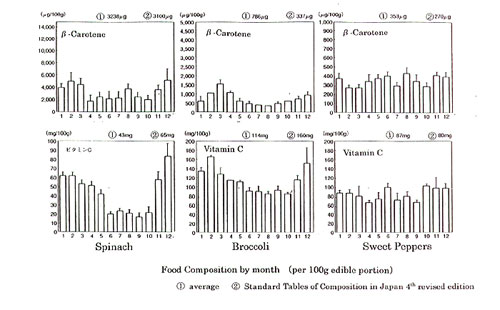
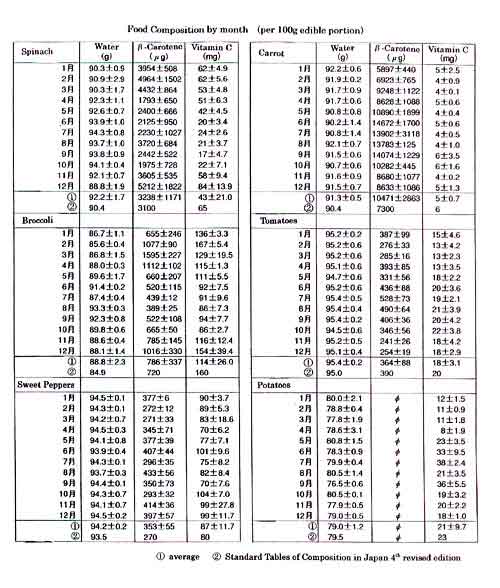
We measured vitamin C and carotene amounts in 25 different kinds of ordinary
vegetables on the market in Tokyo and its suburbs. Comparisons were made
between the values of these nutrients shown in the Standard Tables and
the measurements of the vegetables in season and out of season. The Standard
Tables has adapted the rule of indicating one standard nutrient value for
one food to serve a wide range of purposes. However, considerable seasonal
changes were found in nutrient contents in the examined 25 vegetables,
especially in vitamin C. Only two vegetables showed smaller changes: celery
and sweet peppers. Therefore, it seems that the one-value-for-one-food
rule, on which the indications in the current Standard Tables are based,
can be applied to only a limited number of vegetables. In analyses conducted
throughout one year, significant seasonal changes in nutrient contents
were found for the following vegetables: potatoes, whose vitamin C content
changed significantly between January-April values and May-September
values; tomatoes, whose carotene content changed significantly between
November-December values and June-August values; carrots, whose carotene
content changed significantly between January-February values and May-October
values; broccoli, whose carotene and vitamin C contents changed significantly
between July-August values and December-April values; and particularly,
spinach, whose vitamin C content changed greatly between June-October
values and November-February values and dwindled from March to May. Although
cooking materials are crude animal and vegetable products with a considerable
range of variation in their nutrient contents, from the results of this
experiment we must admit that one-value-for-one-food indications have only
limited use. In particular, the spinach and broccoli on the market from
May through October contain less vitamin C than those available in season
(from November through February). Since these are among common vegetables
expected to contain a large amount of nutrients, it has been considered
that another set of nutrient indications is necessary for these vegetables
in these seasons. The Standard Tables should be rearranged as a more accurate,
basic tool for the calculation of nutrient values.
It was suggested that the indications of either seasonal values or the
respective values for seasons and other seasons are necessary for ordinary
foods in each individual district. Currently, the Standard Tables of Food
Composition are used in a wide range of situations including not only nutritional
control for school lunches and hospital meals, and nutritional guidance
for diet and medical treatment, but also in daily life in general households.
Inconvenience in the use of the Standard Tables must be therefore avoided,
but improvement should be actively attempted. How can the one-value-for-one
food indications be combined with seasonal changes in the nutrient values
of natural foods? Considering this, it seems necessary to collect more
data on nutrient contents in foods
Traditional Vegetables in Japan
Our interest in food might be restricted to foods which are familiar or
those we have often eaten in our childhood, and we might be less inclined
to eat something we have never eaten, though the case might not be the
same for young people recently. According to literature, it took 50 years
for tomatoes and cabbage to be accepted in Japan, which is unbelievable
in consideration of the current gourmet boom. However, remembering the
tension I experienced in the mouth when I first ate Thai food or Indonesian
food in these respective countries, such historical fact might be convincing.
Takamiya et al. reported in their study on Japanese vegetables that among
currently familiar vegetables, only a handful are indigenous to Japan.
Some examples are butterburs, mitsuba (a green vegetable with a distinct
celery-like flavor), Japanese parsley, burdocks, thistles, wasabi (Japanese
horseradish), Japanese pepper, and myoga (a vegetable with a distinct flavor
whose buds are eaten). It is certainly impossible to live on these indigenous
vegetables, since it would result in nutritional deficiency, especially
in vitamins and minerals. Although radishes and turnips are not indigenous
to Japan, they have a long history in Japan, longer than that of eggplant
and cucumbers. Descriptions of soybeans, turnips, ginger, and radishes
can be found in the ancient records "Kojiki" and "Nihon-shoki", both written
in the Nara era. In "Man-yo-shu", an anthology of tanka compiled in the
same era, taros, leeks, lotuses, and melons are mentioned. In the Edo era,
it seems that pumpkins, carrots, spinach, and watermelons had been introduced
into the daily diet of Japanese people. The Meiji government introduced
many kinds of vegetables from Europe and America and encouraged people
to grow them in many parts of Japan. However, many of these vegetables
did not suit contemporary Japanese eating habits and tastes, and so did
not take root in the general public. Nonetheless, some of the vegetables
experimentally cultivated at that time, including cabbage, onions, and
carrots, have become part of the Japanese diet in the long run, becoming
some of the common vegetables in the current Japanese diet.
A New Study Report on Vitamin C
-The Relationship to Blood Pressure and Blood Cholesterol-
Toohey et al. reported, in their epidemiological research which used the
followers of the Seventh Day Adventist Church (a Christian denomination
who make Saturday a holy day), that a high level of ascorbic acid (AsA)
in the blood serum reduces the risk of cardiovascular disease. They concluded
that ingesting 200mg or more of AsA from meals was extremely effective
for the metabolism of cholesterol in adults.
AsA is an antioxidant soluble in water, and is known to inhibit the oxidation
of LDL, as does vitamin E. It is becoming clear that AsA has an anti-arteriosclerotic
function and regulates the metabolism of lipoproteins. Toohey et al. collected
vegetarian, semi-vegetarian, and non-vegetarian volunteers from the Seventh
Day Adventists, and conducted an experiment whose subjects were 126 females
and 42 males. The results were as follows:
1. A high AsA level in the blood serum lowers systolic and diastolic
blood pressures.
2. A low AsA level in the blood serum raises the LDL cholesterol level
in the blood, therefore raising the total cholesterol level in the blood.
3. A high AsA level in the blood serum raises the HDL cholesterol level
in the blood, therefore lowering the total cholesterol level in the blood.
Blood cholesterol in advanced animals consists of lipoproteins existing
in the blood together with triglyceride, phospholipids, and several types
of proteins, and is transported to many parts of the body. In the human
body, there are four types of lipoproteins: very low-density lipoprotein,
intermediate-density lipoprotein, low-density lipoprotein (LDL), and high-density
lipoprotein (HDL). LDL transports lipids from the liver to peripheral tissues,
and HDL transports lipids from peripheral tissues to the liver. Therefore,
an increased LDL cholesterol level and a decreased HDL cholesterol level
increase the risk of arteriosclerosis and myocardial infarction. Moreover,
oxidized LDL which results from the oxidation of LDL may lead to atherosclerosis.
This research found that ingesting 200mg/day or more of vitamin C from
meals (at least twice as much as the 100mg/day determined by the Sixth
Revised Recommended Dietary Allowances in Japan) was effective in improving
the metabolism of cholesterol in the blood. However, in order to obtain
this effect, it may not be enough to just ingest 200mg of AsA but may be
necessary to ingest it through meals, meaning through vegetables.
Incorporation of Seasonal Changes in Vitamin C Content in Vegetables
into the Standard Tables
Vegetables are raw cooking materials, and it is therefore necessary to
allow some variation in their nutrient contents. However, for the purpose
of ingesting at least 200mg/day of vitamin C from meals, which is more
than four times the current recommended dietary allowance, the one-value-for-one-food
indications in the Standard Tables reduces the reliability of calculations
of nutrition values. For example, the range of seasonal changes in vitamin
C content in vegetables should be shown in comparison to standard content.
Although some vegetables currently have long seasons, the data from nutrient
analysis conducted around 1980, on which the Fourth Revised Standard Tables
of Food Composition was based, might have included data only on vegetables
in season, when nutrients are abundant, but not on out-of-season products.
Based on the results from nutrient analysis conducted throughout one year,
the one-value-for-one-food indications should be reconsidered.
Conclusion
After the completion of research on seasonal changes in vitamin C and carotene
contents in vegetables, reconsideration of the subject matter brings the
notion that we have entered a time when the current one-value-for-one-food
rule in the Standard Tables will no longer do. Among common vegetables
with high nutritional value, it is desirable that those whose nutrient
contents vary by several folds in a year (spinach, broccoli, carrots, etc.)
have two or seasonal values.
Today, in mass lunch planning such as in hospitals, schools, and offices,
the data in the Standard Tables has been entered in computers, on which
lunch menus and the calculation of nutritional values are based. It should
be known that seasonal changes in nutrient contents are great. This being
the case, what is the situation, then, for marine foods and dairy products?
I hope such data will be released on foods other than vegetables and be
utilized extensively for school lunch programs and so on. |