This is 100th anniversary newsletter, so it has greeting mail from advisor of VIC-Japan and scientists who contact with us.

Two examples of their comments are written.

1st page: Advisors of VIC-Japan

Ÿ Prof.Emeritus. N.Hosoya (University of Tokyo)
Congratulations on the issuance of the 100th memorial issue of the VIC Newsletter.
There have been conventional reports on the chemistry and functions of simple vitamins. Currently, one of the issues attracting attention is the chemical formations of coexisting vitamins and the actions of each kind of vitamin under such conditions. Whether coexisting vitamins show additive, synergistic, or inhibitory action has become a matter of concern and is under discussion.
As for vitamins contained in food, their bioavailability has become a matter of interest and is under discussion.
In addition, in the context of risk factors causing chronic non-infectious diseases, especially lifestyle-related diseases, the effect of vitamins on the reduction of such risks has also become a matter of interest.
The Vitamin Information Center is expecting the continued contribution of precise new information about vitamins by researchers. It is our everlasting hope that our activities will contribute to the maintenance and promotion of public health as well as to the prevention and treatment of disease.

Ÿ Prof.Emeritus. O.Igarashi (Ochanomizu Women's University)
Ÿ Prof. N.Hashizume (Toho University School of Medicine)
Ÿ Prof. T.Yoshikawa (Kyoto Prefectural University of Medicine)


2nd-4th page: Prof. Ito (Fujita Health University)

Ÿ Prof. Y.Ito (Fujita Health University)
I would like to offer my heartfelt congratulations on the 100th issue of the VIC Newsletter of the Vitamin Information Center. I would also like to extend my deepest gratitude for the great effort and hard work used in making the newsletters, as they have made a large contribution to the study of vitamins by providing such information as up-to-date findings concerning vitamins and by serving as a guide to studies of vitamins. In particular, various special reports and elaborately prepared contents on subjects such as international findings concerning vitamins, the latest research results produced by specialists, and accurate recent research results concerning topical subjects such as carotenoids have made an inestimable contribution not only to my work but also to that of many other people. Furthermore, the recent completion of the analysis of the human genome has accelerated the analysis of the function(s) of each genome piece, which is expected to increase the importance of and knowledge about vitamins and related substances by elucidating unknown functions of such substances on various vital phenomena. This will further expand the role played by the VIC Newsletter. We who work on vitamins and related substances are thus earnestly looking forward to the further expansion and development of the newsletter.

Ÿ Prof. W.Sakamoto (Hokkaido University)
Ÿ Prof. H.Tamai (Osaka Medical College)
Ÿ Prof. I.Tomita (Shizuoka Sangyo University)
Ÿ Assoc Prof. Y.Tomita (Miyazaki University)
Ÿ Dr. S.Tsugane (National Cancer Institute)
Ÿ Prof. M.Tsujimura (Kagawa Nutrition University)
Ÿ Prof. E. Niki (Utsunomiya University)
Ÿ Dr. F. Hirahara (National Institute of Health and Nutrition)
Ÿ Prof. Emeritus. T.Hirohata (Kyusyu University)
Ÿ Prof. S.Masushige (Tokyo University of Agriculture)
Ÿ Prof. Emeritus. M.Mino (Osaka Medical College)
Ÿ Prof. T.Miyazawa (Tohoku University)
Ÿ Prof. Y.Muto (Sugiyama Jogakuen University)
Ÿ Prof. A.Murata (Saga University)
Ÿ Prof. K.Yausda (Kagawa Nutrition University)
Ÿ Assoc. Prof. T.Watanabe (Yamagata University) 


Reduction of Plasma Homocysteine Levels by Breakfast Cereal Fortified with Folic acid in Patients with Coronary Heart Disease 
(The New Eng. J. Med. 1998,338;15,1009-1015)

Place of study: USA
Subjects: 75 men and women with coronary artery disease (age; 45-85)
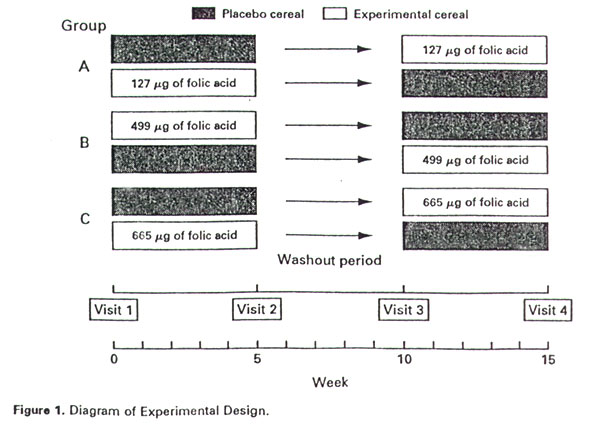
Method: double-blind, placebo-controlled, crossover trial
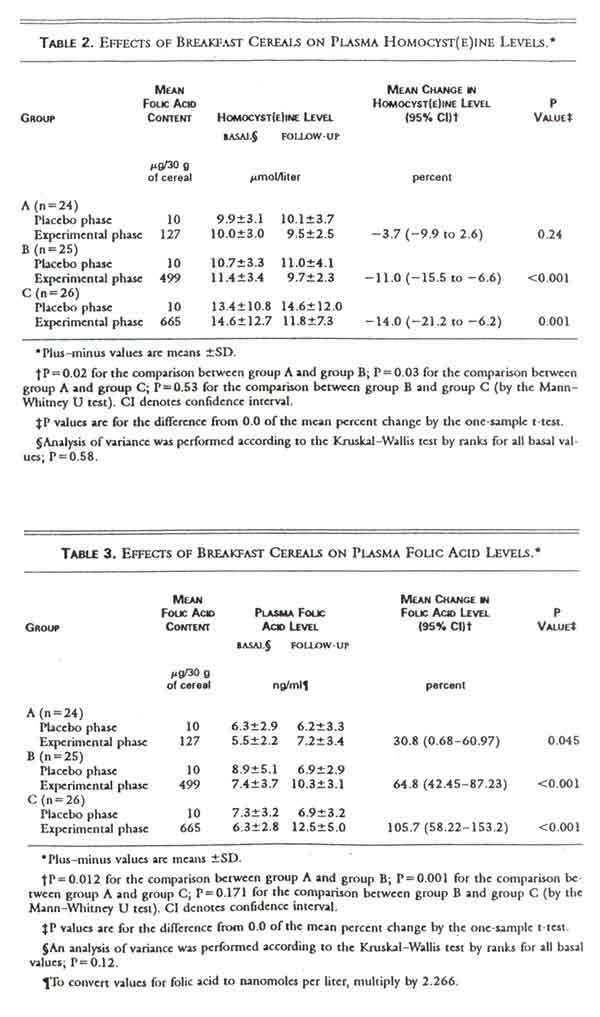
Subject were randomly assigned to receive 30 g of experimental or placebo cereal daily during the initial and final five-week periods. All daily portions of cereals contained the RDAs of vitamins C, E, B1, B2, B3, B5, B6, B12, iron, and zinc; 25 percent of the RDA of vitamin A; and 10 percent of the RDA of vitamin D. Three levels of folic acid fortification were used in the experimental cereals; the mean (}SD) folic acid content per 30 g of cereal was 127 }11 ƒĘg (group A), 499}6ƒĘg (group B), or 665}48ƒĘg (group C). The placebo cereal contained the above-mentioned vitamins and minerals, except for folic acid and vitamin B6 and B12. The naturally occurring amounts of these vitamins were 10}0.9, 0.11}0.02, and 0.13}0.02ƒĘg per 30 g of cereal, respectively. Basal plasma levels of homosysteine and vitamins were measured at visits 1 and 3; follow-up levels were measured at visits 2 and 4.

Results: Cereal providing 665ƒĘg folic acid daily increased plasma folic acid levels by 105.7%, decreased plasma homocysteine level by 14.0%. 


Increased Plasma Homocysteine after Withdrawal of Ready-to -Eat Breakfast Cereal from Diet: Prevention by Breakfast Cereal Providing 200ƒĘg Folic Acid
(J.Am. Colle. Nutr. 2000; 19:452-457)


Objective: We tested the hypothesis that cessation of habitual ingestion of breakfast cereals would be associated with elevated plasma homocysteine concentrations. We anticipated that those subjects who reported consuming breakfast cereals containinf 100 to 400ƒĘg of folic acid per serving before entering the study would achieve higher plasma homocysteine concentrations if, in addition to their regular diet, they began ingesting a daily serving of breakfast cereal that contained less than 10ƒĘg of folic acid per serving.

Design: Seventy-nine subjects consumed a daily serving of breakfast cereal containing either <10ƒĘg of folic acid per serving (placebo) or breakfast cereal containing 200ƒĘg of folic acid per serving (folic acid fortified)

Results: Cessation of intake of commercially available breakfast cereal was associated with homocysteine elevation. Breakfast cereal containing 200ƒĘg folic acid per day was sufficient to maintain the homocysteine lowering effects of commercial cereals.

Conclusions: Habitual consumption of commercially available fortified breakfast cereals, usually containing 100 to 400ƒĘg folic acid per serving, had significant homocysteine-lowering effects as shown by the homocysteine increase after cessation of habitual intake of commercial breakfast cereal. Substitution of breakfast cereal containing only 200ƒĘg folic acid per day was sufficient to maintain the homocysteine-lowering effects of commercial cereals.


An Update on folates and folic acid: contribution of MAFF-funded research
(Nutrition Bulletin, 25,113-124)


The Ministry of Agriculture, Fisheries and Food (MAFF) recently commissioned the British Nutrition Foundation to review critically its Optimal Nutrition Status program and identify future research requirements.

Contribution of MAFF projects to knowledge about folates and folic acid
1. Dietary folate, homocysteine and endothelial function with methylene tetrahydrofolate reductase (MTHFR) genotype.
2. The plasma homocysteine lowering effects of dietary intervention vs folate supplementation (A collaboration with the project above)
3. Quantitative studies in the bioavailability of folate in food using isotope ratio mass spectrometry.
4. Is folic acid considerably more effective than folates at raising folate status?
5. Bioavailability of folic acid and natural folates: studies using the functional maeker plasma homocysteine


Vitamin A teratogenicity and risk assessment in the macaque retinoid model 
(Reproductive Toxicology 14, 2000)


Vitamin A is an essential nutrient required for many biologic processes. The role of vitamin A in normal reproduction and development, however, must be strictly regulated. It has been recognized for many years that both deficiency and excess of vitamin A during pregnancy are teratogenic in animals. The potential teratogenicity of excessive Vitamin A in humans, however, is less certain due to limited or conflicting data on this topic. This lack of definitive clinical and epidemiologic data and the ethical impehiment against doing clinical trials in humans with high doses of Vitamin A supports the use of an appropriate animal model to predict safe levels of this nutrient during pregnancy. The validity of using the cynomolgus monkey (Macaca fascicularis) in this capacity has been verified in earlier studies that demonstrate that embryonic development in this nonhuman primate very closely parallels that of human embryos. Most importantly, the cynomolgus macaque has been clearly established as an appropriate model of 13-cis-retinoic acid (13-cis -RA) teratogenicity.

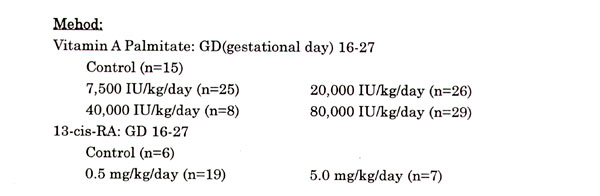
Mehod:
Results:
<Developmental toxicity>
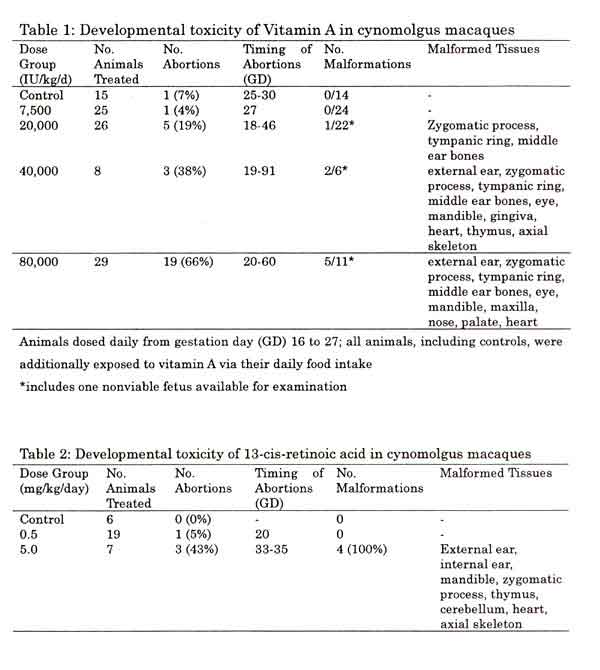
Treatment of pregnant macaques with excessive doses of Vitamin A during gastrulation and early organogenesis had adverse developmental effects manifested as dose-related increases in abortion and malformation (table 1). The majority of losses in all groups occurred early in pregnancy, GD 18 through 30 (62%) and GD 31 through 45 (28%).
The primary target for retinol-induced dysmorphogenesis was the crainofacial region. The external was the most frequently affected target organ; six of the eight malformed fetuses exhibited unilateral or bilateral ear defects. These defects consisted primarily of hypoplasia of one or more areas of the ear derived from the first pharyngeal arch (helix, crus of helix) or second pharyngeal arch (auricular tubercle, crura of antihelix, lobule, and antitragus). Absent external auditory canals and accessory skin tag rostral to the ear were also observed at a low incidence. Other frequently affected target organs in the craniofacial region were the mandible (hypoplastic), zygomatic processes (hypoplastic, or abnormally shaped), tympanic rings (hypoplastic), and middle ear bones (abnormal malleus, incus, and/or stapes). The eye (open, hypertelorism, exophthalmia), maxilla (hypoplastic), nose (hypoplastic), palate (arched or cleft), and greater wing of the sphenoid bone (hypoplastic) were also targets of retinol toxicity.

<affects of 13-cis-retinoic acid>
There was marked development toxicity associated with the high dose (5 mg/kg) of 13-cis-retinoic acid. There was a significant increase in abortions (43%) occurring between GD 33 and 34. Moreover, all four of the surviving fetuses exhibited one or more malformations indicative of retinoid embryopathy. (Table2)